
A short resignation letter does one job. It tells your employer you’re leaving and gives your last working day. If you’ve been staring at a blank page, trying to sound polite, grateful and impressive all at once, you can stop. Nobody in HR is grading your writing.
This page gives you copy-ready samples, a simple format and the few details that matter. If you want the full structure behind these samples, our resignation letter format guide covers it.
What Is a Short Resignation Letter?
A short resignation letter is a brief, formal note, usually 50 to 120 words. It confirms that you are resigning, names your last working day and, if you like, thanks your employer. It leaves out the long explanation, the career story and any feedback about management.
Short doesn’t mean casual or optional. Many companies want a written copy on file before they process your final settlement, leave balance or relieving letter. The note is quick to write, but it ends up in your HR record.
When a Short Resignation Letter Works
For most jobs, short is the right call. A private-sector role, a notice period you can serve, a reasonable manager: a few clear lines are enough.
A longer letter makes sense in a few cases. Senior roles often need a handover plan. Some schools and colleges expect a formal structure, so check our resignation letter for teacher guide if that’s you. If your contract asks for specific wording, follow the contract.
What a Short Resignation Letter Must Include
Four things, and in this order:
- A clear statement that you are resigning, with your job title.
- Your last working day, worked out from your notice period.
- One line of thanks (optional, but it costs you nothing).
- Your name and signature. Add your employee ID if your company uses one.
That’s the whole letter. For a deeper walkthrough, read how to write a resignation letter.
Short Resignation Letter Samples
Sample 1: The Two-Line Version
Use this in informal workplaces or when your manager already knows.
Dear [Manager’s Name],
I am resigning from my position as [Job Title], effective [Last Working Day]. Thank you for the opportunity to work here.
Regards,
[Your Name]
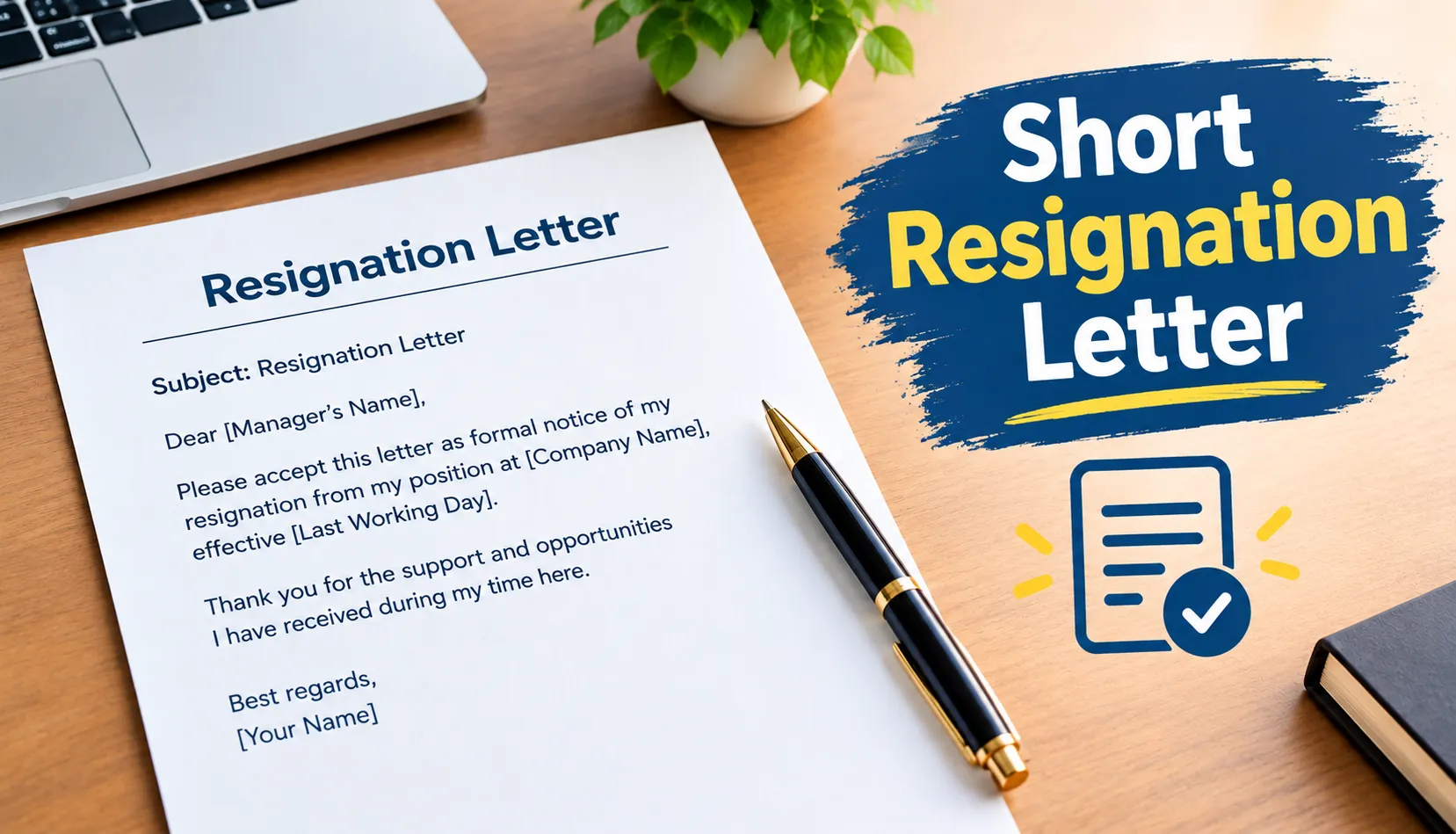
Sample 2: The Standard Short Letter
This one suits most office jobs and takes about a minute to personalise.
Subject: Resignation – [Your Name]
Dear [Manager’s Name],
Please accept this letter as formal notice of my resignation from the position of [Job Title] at [Company Name]. My last working day will be [Date], in line with my [30]-day notice period.
Thank you for the support and opportunities I’ve had here. I’ll help hand over my work before I leave.
Sincerely,
[Your Name]
[Employee ID]
Sample 3: Short Resignation Email
Email works well for remote and hybrid teams. The subject line matters here, so see these resignation letter subject examples.
Subject: Resignation – [Your Name], [Job Title]
Hi [Manager’s Name],
I’m writing to resign from my role as [Job Title]. My last working day will be [Date]. Thank you for everything I’ve learned here. I’m happy to help with the handover.
Best regards,
[Your Name]
Sample 4: Short Letter for Personal Reasons
Dear [Manager’s Name],
I am resigning from my position as [Job Title] at [Company Name] for personal reasons. My last working day will be [Date]. I appreciate your understanding and will make the handover as smooth as I can.
Sincerely,
[Your Name]
You don’t have to explain “personal reasons” any further. Our personal reason resignation letter format guide has more wording options.
Which Short Version Should You Use?
| Version | Best For | Length | Tone |
| One or two lines | Small teams, informal workplaces | 20 to 40 words | Plain and direct |
| Standard short letter | Most private-sector jobs | 60 to 100 words | Professional, neutral |
| Short email | Remote or hybrid roles | 40 to 80 words | Polite, quick |
| Personal reasons | Family, health or relocation | 50 to 90 words | Private, brief |
| Immediate resignation | Emergencies or buyout terms | 60 to 100 words | Firm, respectful |
How to Write One in Five Minutes
- Check your notice period first: Look at your offer letter or contract. A wrong last day is the most common error.
- Open with the decision: Put “I am resigning” in the first sentence, not the third.
- Add the date: Write the exact calendar date, not “in 30 days.”
- Thank them, if you mean it: One sentence is plenty. If it feels fake, leave it out.
- Offer a handover: One short line is enough.
- Sign and save a copy: Keep a signed copy or your sent email for your records.
If you want a ready-made layout, the simple resignation letter sample page has more templates, and the resignation letter format Word page covers setting it up as a document.
What to Include and What to Leave Out
| Include | Leave Out |
| Your job title and company name | Complaints about your manager or team |
| Exact last working day | Details of your next job |
| A single line of thanks | Long explanations of why you’re leaving |
| An offer to hand over work | Salary or promotion disputes |
| Your name and signature | Casual slang or jokes |
Common Mistakes in Short Resignation Letters
Shortness doesn’t protect you from mistakes. These are the ones I see most:
- No last working day: It’s the one detail HR needs, and it’s the one people skip.
- Venting: A bad week is not a reason to put it on record. Use the exit interview, or say nothing.
- Over-explaining: One line of reason is already more than you owe anyone.
- Ignoring your contract: If it asks for 60 days’ notice and you write 15, you’ve created a problem.
- Forgetting your copy: If a dispute comes up later, you want proof of when you sent it.
Related Guides for Your Situation
If a short letter isn’t quite right for you, these pages may fit better:
- A job resignation letter with a fuller structure
- An employment resignation letter for formal workplaces
- A general resign letter template with examples
- A resign letter in English for simple, plain wording
- A resignation letter in Hindi if you work in a Hindi-speaking office
Frequently Asked Questions
- How long should a short resignation letter be?
Three to five sentences, or roughly 50 to 120 words. It should fit comfortably on half a page. - Is a one-line resignation letter acceptable?
Often, yes, especially in informal workplaces. Even then, include your name, your job title and your last working day. Some HR teams insist on a formal letter, so ask if you’re unsure. - Can I send a short resignation letter by email?
Yes. Most companies accept it, particularly for remote roles. Use a clear subject line and include the same details you would in a printed letter. - Do I need to give a reason for resigning?
No. You can write “for personal reasons” or skip the reason completely. A short letter works well because there’s no space to over-explain. - Should I mention my notice period?
Yes, in effect. State the last working day, and refer to your notice period if your contract requires it. Check the contract before you send anything. - Should I thank my employer even if I didn’t enjoy the job?
You don’t have to. A brief, neutral thank-you keeps the door open for references. If it feels dishonest, leave it out instead of writing something fake. - Should I keep a copy of my resignation letter?
Always. Save a signed copy or the sent email. It proves when you gave notice if anything is disputed later.
Conclusion
A short resignation letter is enough for almost every exit. State that you’re resigning, give the correct last working day, add one line of thanks if you mean it, and sign off. That keeps you professional, protects your references and gives HR what it needs.
Pick the sample above that matches your situation, swap in your details, and send it. If you need more room or a different format, browse the guides linked above, or start with our resignation letter format page.