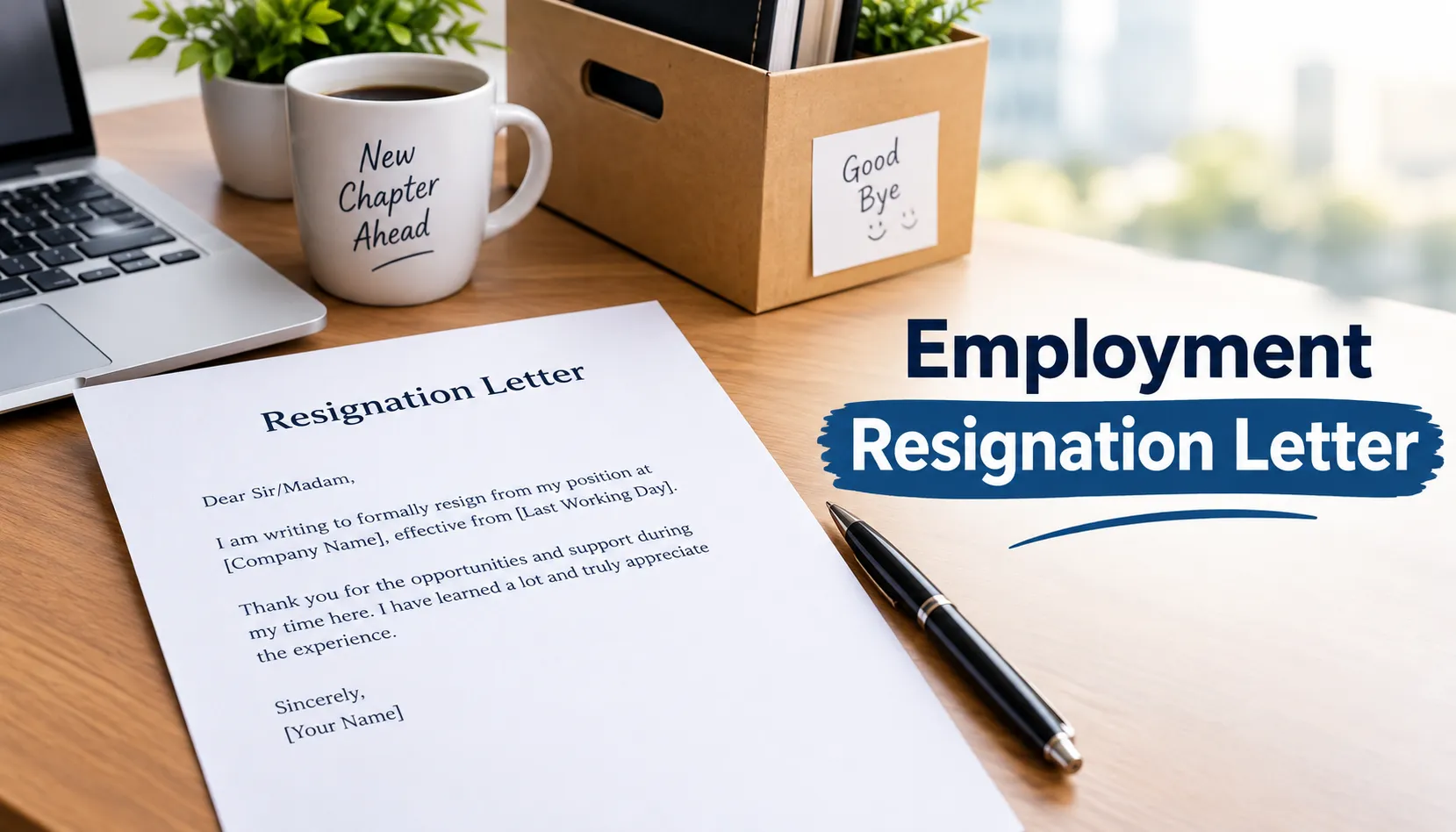

An employment resignation letter is the short, formal note you give your employer to confirm you are leaving your job. It states your last working day, and it can also say why you are going and thank the people you worked with. Most run between 100 and 200 words, so you can write one in about five minutes.
Short does not mean unimportant. This one page decides how HR records your exit, whether your dues get released on time, and what a future employer hears when they call for a reference. This guide covers what to include, the main types, a clean format, notice periods, common mistakes and a sample you can copy.
What Is an Employment Resignation Letter?
It is a written statement telling your employer that you are ending your employment. You address it to your direct manager or HR, date it, sign it and keep it brief.
Plenty of people think of it as paperwork nobody reads. HR reads it, though, and then files it. Many companies will not process your final salary, leave encashment, provident fund withdrawal or relieving letter until a signed copy is on record. If you want a deeper walkthrough, our guide on how to write a resignation letter breaks the process down step by step.
Why You Should Always Put Your Resignation in Writing
Telling your manager in person is a good first step. It is not enough on its own, for these reasons:
- It gives you proof: A dated letter settles any argument about your last working day.
- It starts your notice period: Most contracts count notice from the day you submit written resignation.
- It protects your record: The letter sits in your HR file and backs up your employment history.
- It speeds up your settlement: Experience letters and final dues usually depend on it.
- It leaves a better impression: A calm, polite letter is what people remember when you are gone.
What to Include in Your Employment Resignation Letter
Every good letter covers the same core points. The table below shows what goes where and how much space each part needs.
| Section | What to write | Length |
| Date and address | Today’s date, manager’s name, designation and company name | 2 to 3 lines |
| Subject line | “Resignation: [Your Name]” or “Letter of Resignation” | 1 line |
| Salutation | “Dear [Manager’s Name],” | 1 line |
| Opening statement | A clear line saying you are resigning from your post | 1 to 2 sentences |
| Last working day | The exact date, based on your notice period | 1 sentence |
| Thank-you note | A brief word of thanks for the role or the team | 1 to 2 sentences |
| Handover offer | A promise to help with the transition | 1 sentence |
| Closing | “Sincerely” or “Regards,” with your name, designation and employee ID | 2 to 3 lines |
For a full layout with examples, see our resignation letter format page.
How to Write It Step by Step
- Say you are resigning in the first line: Do not make your manager hunt for the point.
- Name your last working day: Check your contract first, because most notice periods are 15, 30 or 60 days.
- Add one line of thanks: Skip it if it would feel fake. A short, honest sentence is enough.
- Offer to help with handover: It costs you nothing and shows you care about leaving things tidy.
- Sign off formally: Include your full name, designation and employee ID.
- Keep the reason short: You do not have to explain. “For personal reasons” is perfectly acceptable, and our personal reason resignation letter format shows how to word it.
Types of Employment Resignation Letters
Not every exit looks the same, so the letter should fit the situation. Here are the most common versions.
| Type | Best used when | What makes it different |
| Standard resignation letter | You are leaving on good terms | Neutral tone, normal notice period |
| Two weeks’ notice letter | Common in the US and many private roles | States a clear two-week timeline |
| Immediate resignation letter | An emergency, or you are buying out your notice | States immediate departure and may cite a buyout clause |
| Email resignation letter | Remote or hybrid teams | Shorter, sent as an email body or attachment |
| Personal reasons letter | Health, family or relocation | Keeps the reason general |
| Retirement resignation letter | You are retiring, not changing jobs | Mentions retirement date and years of service |
| One-line resignation letter | Informal workplaces | Only the resignation and the last date |
You will find ready-made wording for many of these in our free resignation letter templates and in the resignation letter examples section. If you just want a quick starting point, the resign letter page has a compact version.
Notice Period Guide
Your notice period is the most common source of trouble, so check your offer letter before you write anything. The ranges below are typical, but your contract always wins.
| Role level | Typical notice period | Notes |
| Entry level | 15 to 30 days | Often negotiable with your manager |
| Mid level | 30 days | Standard in most private companies |
| Senior or managerial | 30 to 60 days | Longer handover expected |
| Leadership | 60 to 90 days | Clients or boards may need warning |
| Government and public sector | 30 to 90 days | Depends on service rules |
| Probation | 1 to 15 days | Check the terms in your offer letter |
If you cannot serve the full period, talk to HR before you submit the letter. A resignation letter is not the place to bargain.
Employment Resignation Letter Sample
Here is a simple version you can adapt. Swap in your own details and adjust the tone to suit your workplace.
Dear [Manager’s Name],
I am writing to formally resign from my position as [Job Title] at [Company Name]. My last working day will be [Date], in line with my [notice period] notice period.
Thank you for the opportunities and support I have had here. I am happy to help with handover so the transition is smooth for the team.
Sincerely,
[Your Name]
[Employee ID]
Resignation Letters in Other Languages
If your workplace expects a local language, a translated letter can show respect and avoid confusion. We have separate guides for a resignation letter in Hindi, a Kannada resignation letter and a Korean letter of resignation. The structure stays the same. Only the language and the level of formality change.
Common Mistakes to Avoid
- Venting: Even if you are leaving a bad situation, the letter is not the place to say so.
- Leaving out the last working day: It is the single most important detail, and the one people forget.
- Over-explaining: One line of reasoning is plenty.
- Skipping the contract check: A wrong date can cause payroll and legal headaches.
- Not keeping a copy: Save a signed copy or the sent email for your own records.
- Being too casual: Save the jokes for your farewell chat with the team.
Frequently Asked Questions
- Do I have to give a reason in my employment resignation letter?
No. You can write “for personal reasons” or leave the reason out entirely. Most employers cannot require a detailed explanation. - How long should an employment resignation letter be?
Between 100 and 200 words is the usual range. Three short paragraphs are enough. - Can I send my resignation by email?
Yes, in most companies. Include the same details you would put in a printed letter: your intent to resign, your last working day and your name. - How much notice should I give?
Check your offer letter first. Many companies expect 15 to 30 days, and senior roles often need 60 or 90. - Should I mention my new job?
It is not necessary, and it is usually better to leave it out. Keep the letter about your departure. - Do I need to thank my employer if I disliked the job?
No. A short, neutral line of thanks can help with future references, but if it feels dishonest, simply leave it out. - What is the difference between a resignation letter and a relieving letter?
You write the resignation letter to tell your employer you are leaving. The company issues the relieving letter afterwards to confirm your last day and your formal release.
Conclusion
A strong employment resignation letter is short, polite and precise. State that you are leaving, give your last working day, thank people if you mean it, and keep a copy. That is all HR needs to process your exit without delay.
Start with the sample above, then pick a version that fits your situation from our resignation letter format guide or our free templates. If you get stuck, you can always reach us through the contact page.