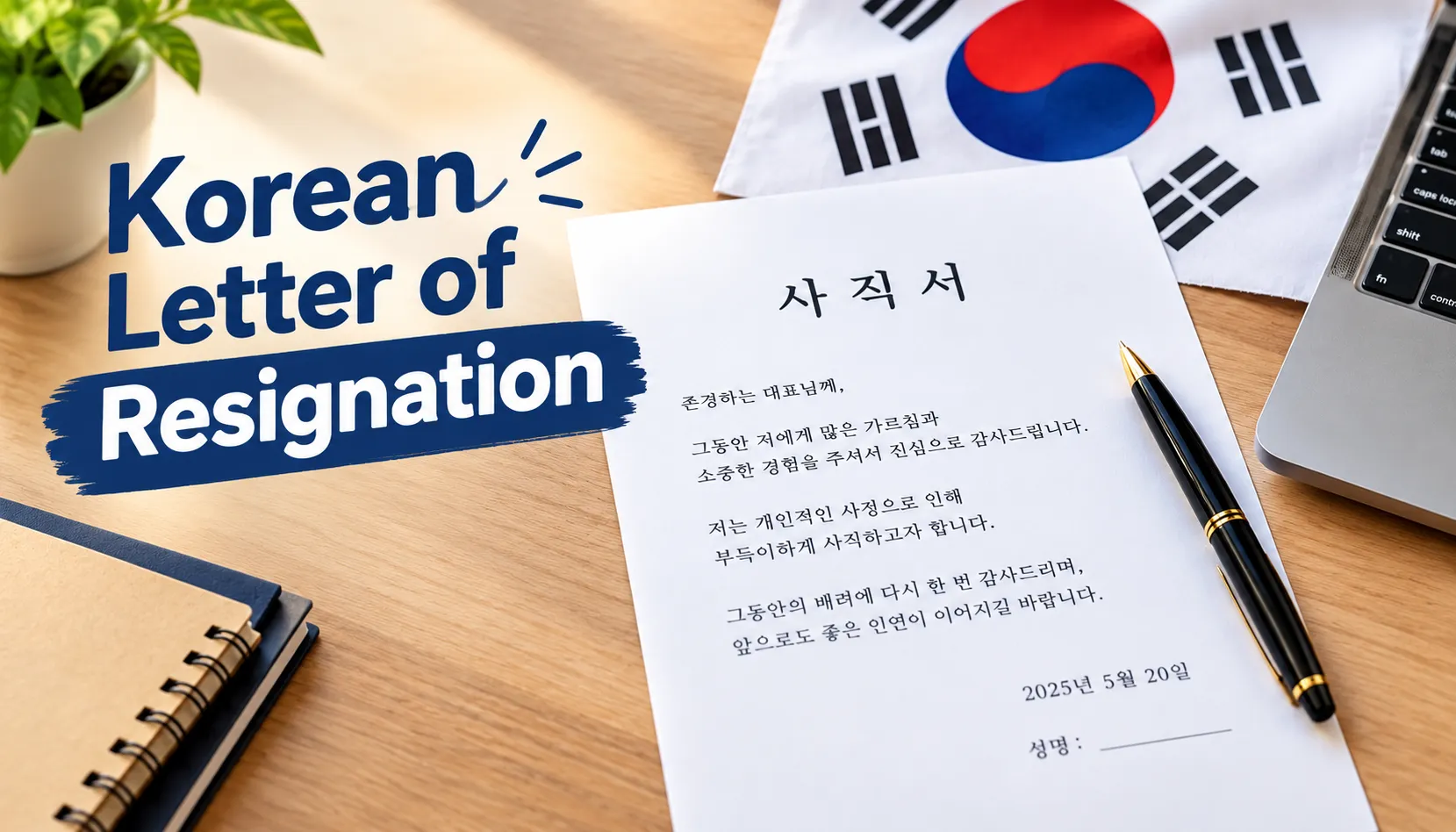

A Korean letter of resignation is called a 사직서 (sajikseo). If you work in South Korea, you will almost certainly be asked to submit one, even after you have told your manager in person. Korean workplaces care about paperwork and about how you leave. A short, polite, correctly formatted letter protects your severance pay, your reference, and your reputation.
This guide covers the exact format, a ready-to-use Korean template with an English translation, notice period rules, and the mistakes foreign employees make most often.
What Is a Korean Letter of Resignation?
A 사직서 is a short formal document in which you state that you want to leave your job and give your intended last day. It is much shorter than a Western resignation letter. You do not thank the whole team or explain your career plans. Most Korean letters are five or six lines long.
If you want to see how a standard English letter is built first, our guide to the resignation letter format is a good starting point. The Korean version follows the same logic with tighter wording and stricter etiquette.
Korean Resignation Terms You Should Know
You will hear several words for the same thing. HR staff use them loosely, so it helps to know the differences.
| Korean Term | Romanization | Meaning | When You Will See It |
| 사직서 | sajikseo | Letter of resignation | The most common term for a formal letter |
| 사직원 | sajikwon | Request to resign | Slightly softer; you are “asking” to leave |
| 사표 | sapyo | Resignation slip | Casual, spoken; “사표를 내다” means “to quit” |
| 퇴직원 | toejikwon | Retirement or exit request | Often used for retirement or contract ends |
| 권고사직 | gwongo sajik | Recommended resignation | Employer asks you to leave; different benefits apply |
| 퇴직금 | toejikgeum | Severance pay | Paid after one year of continuous service |
The last two matter most. If you resign on your own, you submit a 사직서. If your company pushes you out and calls it 권고사직, read every line before signing, because it can affect unemployment benefits.
What to Include in a Korean Resignation Letter
Keep it plain. HR only needs a handful of details.
| Element | What to Write | Notes |
| Title | 사 직 서 | Centered at the top, often with spaces between the characters |
| Department (소속) | Your team or department | Your team or department |
| Position (직위) | Your rank or title | For example 사원, 대리, 과장 |
| Name (성명) | Your full name | Family name first |
| Hire date (입사일) | Date you joined | Helps HR calculate severance |
| Last day (사직 예정일) | Your intended final day | Match it to your notice period |
| Reason (사직 사유) | Usually 일신상의 사유 | Means “personal reasons” |
| Closing line | 위와 같이 사직하고자 하오니 허락하여 주시기 바랍니다 | Standard polite phrase |
| Date | Letter date | Written year, month, day |
| Signature | Name plus 인 (seal) or signature | Stamp or sign as your company requires |
| Recipient | Company name plus 대표이사 귀하 | “To the CEO” |
Korean Letter of Resignation Sample (Korean and English)
Here is a template you can copy and adjust. Replace the example details with your own.
Korean version
사 직 서
소속: 마케팅팀
직위: 대리
성명: 김민수
입사일: 2022년 3월 4일
사직 예정일: 2026년 11월 30일
사직 사유: 일신상의 사유
위와 같은 사유로 사직하고자 하오니 허락하여 주시기 바랍니다.
2026년 10월 30일
성명: 김민수 (인)
주식회사 ABC 대표이사 귀하
English translation
Letter of Resignation
Department: Marketing Team
Position: Assistant Manager
Name: Minsu Kim
Date of hire: March 4, 2022
Intended last day: November 30, 2026
Reason: Personal reasons
For the reason stated above, I respectfully request permission to resign.
October 30, 2026
Name: Minsu Kim (seal)
To: CEO, ABC Co., Ltd.
Notice what is missing. There is no long thank-you paragraph and no explanation of your next job. In Korea, “personal reasons” is the accepted, respectful default, and nobody will push you to say more in writing.
If you need a more detailed English letter for a foreign company or for your own records, browse the resignation letter sample collection and adapt one.
Step-by-Step: How to Write a Korean Letter of Resignation
- Tell your manager first: In Korea, handing a letter to someone who has not heard the news is considered rude. Ask for a short private conversation with your direct supervisor (팀장) before anything goes on paper.
- Check your contract and company rules: Look for the notice period in your employment contract or 취업규칙 (work rules). Many companies ask for 30 days.
- Write the letter by hand or type it: Some traditional companies still prefer handwriting with a stamp. Larger firms usually accept a typed, printed copy. Ask HR which they want.
- Use polite, formal language: Stick to 하오니 and 바랍니다 style endings. Casual speech in a formal document looks careless.
- Submit it to the right person: This is usually your team leader first, then HR (인사팀). Keep a copy or a photo for yourself.
- Ask about handover and final pay: Confirm your last working day, handover tasks, unused annual leave, and when your severance will arrive.
Notice Period in Korea
Korean law and company practice do not always match, so it pays to know both.
Under the Civil Act, for an open-ended employment contract, either side can end it at any time, and the termination takes effect one month after the other side receives notice. That is where the common 30-day expectation comes from. Your own contract may say something different, and many companies add their own rules on top.
In practice, giving less than a month can cause friction even if you feel legally comfortable. Some employers hold up the handover, and word travels fast in tight industries. If you only plan to give two weeks, our guide to a two weeks notice resignation letter explains how to word it. If you need to leave sooner, see the tips on an immediate resignation letter.
This is general information, not legal advice. For a disputed contract or unpaid wages, contact the Ministry of Employment and Labor or a labor attorney (노무사).
What Happens to Your Severance and Final Pay
Resignation does not mean you lose what you have earned. A few basics:
- Severance pay (퇴직금): Generally owed if you worked continuously for at least one year and averaged at least 15 hours a week. It is roughly 30 days of average wages for each year of service.
- Payment deadline: Employers are normally expected to pay wages and severance within 14 days after your employment ends, unless both sides agree to extend it.
- Unused annual leave: Many employees are paid for leave they did not take. Ask HR to confirm the number of days.
- Unemployment benefits: Voluntary resignation usually does not qualify. Exceptions exist for specific reasons, such as unpaid wages or unsafe conditions, so check with the employment center (고용센터) before you submit.
That last point catches people off guard. If you are considering 권고사직 instead, ask what the company will write as the reason for leaving.
Sending a Korean Resignation Email
More Korean offices now accept email, especially at startups and foreign-owned firms. Keep the subject line simple, such as “사직서 제출드립니다 – 김민수 (마케팅팀)”. Attach the signed letter as a PDF and write two or three polite lines in the body. Our resignation email examples show how to keep the tone right in English.
Common Mistakes to Avoid
| Mistake | Why It Hurts | Better Approach |
| Sending the letter before talking to your boss | Seen as disrespectful | Speak in person first |
| Listing complaints or blaming colleagues | Stays in your file and can follow you | Write “personal reasons” |
| Wrong honorifics or casual language | Looks careless | Use formal 하오니 endings |
| Forgetting the last day | HR cannot plan the handover or pay | State a clear date |
| Skipping the seal or signature | Some HR teams will not accept it | Ask what they require |
| Not keeping a copy | No proof if a dispute starts | Photograph or scan it |
| Resigning before securing a new job | Long gap without benefits | Confirm your next step first |
Tips for Foreign Employees in Korea
If you are on an E-2 or another work visa, resigning has extra consequences. Your visa is tied to your employer, so you generally have a limited window to change employers or leave the country after your job ends, and your new employer must go through the change process. Speak to immigration or a visa specialist before you submit your letter.
Also ask HR for a certificate of employment (경력증명서) before your last day. You will need it for future jobs and visa applications, and it is far easier to get while you are still on the payroll.
Frequently Asked Questions (FAQs)
What is a letter of resignation called in Korean?
The formal term is 사직서 (sajikseo). You may also hear 사직원, 사표, or 퇴직원, but 사직서 is the standard word for a resignation letter.
How long should a Korean resignation letter be?
Short. Most are only a few lines, listing your department, position, name, hire date, last day, and reason. One page at most.
Do I have to give a reason for resigning in Korea?
You can write 일신상의 사유 (personal reasons), which is normal and accepted. You do not have to explain further in the letter.
How much notice do I need to give?
Many contracts and company rules ask for 30 days, which also matches the Civil Act rule for open-ended contracts. Check your own contract, since terms differ.
Can my employer refuse my resignation?
For a standard open-ended contract, an employer generally cannot force you to stay. Problems usually arise over timing, handover, or pay, not the right to leave.
Should I write the letter in Korean or English?
Write it in Korean if your company operates in Korean. Foreign-owned companies often accept English. If unsure, submit a Korean version with an English copy attached.
Do I need a handwritten letter and a seal?
It depends on the company. Traditional employers may want a handwritten letter with a stamp (인), while many others accept a printed copy with a signature. Ask HR.
Will I get severance if I resign?
If you have worked at least one year continuously and meet the weekly hours requirement, you are generally entitled to 퇴직금 whether you resign or are dismissed.
Can I claim unemployment benefits after resigning?
Usually not, unless you left for a recognized reason such as unpaid wages or unsafe working conditions. Check with your local employment center first.
Conclusion
A Korean letter of resignation is simple once you know the pattern: title, your details, last day, “personal reasons,” the standard polite closing, date, seal, and the CEO’s name. The letter itself takes ten minutes. The parts that matter more are the conversation with your manager beforehand, the notice you give, and the follow-up on severance and paperwork.
Keep it short, keep it formal, and keep a copy. If you want more examples in English, explore the full resignation letter library on our site and pick the style that fits your situation.