
You’ve decided to leave, and now you need a job resignation letter that does its work without causing trouble. A job resignation letter is a short, formal note that tells your employer you’re leaving, names your last working day, and keeps your exit on record. Most are between 100 and 200 words, so you can write one in about five minutes.
This page covers what to include, how to structure it, the types you might need, common mistakes, and answers to the questions people ask most. Each section links to a detailed guide on this site if you want more.
What Is a Job Resignation Letter?
A job resignation letter is a written statement that ends your employment. You address it to your manager or HR, date it, and keep it brief.
It may feel like a formality, but companies often ask for a signed copy before they release your final pay, leave encashment, or provident fund dues. HR also keeps it on file, and it can come up when a future employer runs a reference check. If you want a quick overview of every format, the resign letter guide is a good place to start.
Why You Should Always Put Your Resignation in Writing
Telling your manager in person is polite, but it isn’t enough on its own. A written job resignation letter helps you in five ways:
- It’s proof: A dated letter settles any argument about your last day.
- It starts your notice period: Most contracts count notice from the date you submit it.
- It protects your record: You may need it later to show continuous employment.
- It leaves a good impression: A calm, short letter is what people remember.
- It speeds up your settlement: Experience and relieving letters are easier to get when your resignation is on file.
How to Write a Job Resignation Letter, Step by Step
The structure is the same almost everywhere. Here is the quick version. For a fuller walkthrough with samples, see how to write a resignation letter.
- Say you’re resigning in the first line: Don’t make the reader hunt for it.
- Add your last working day: Work it out from your notice period, which is commonly 15, 30, or 60 days.
- Thank them briefly: One honest sentence is enough.
- Offer to help with the handover: It shows you care how things end.
- Sign off formally: Include your name, designation, and employee ID if you have one.
- Keep the reason short or leave it out: You don’t owe anyone a long explanation.
Job Resignation Letter Format
Whether you work in a corporate office, a school, or a government department, the layout below works. Our resignation letter format page has editable versions of it.
| Section | What to Write | Length |
| Date and address | Today’s date, manager’s name, company name | 2-3 lines |
| Subject line | “Resignation – [Your Name]” | 1 line |
| Salutation | “Dear [Manager’s Name],” | 1 line |
| Opening | A clear statement that you are resigning from your post | 1-2 sentences |
| Last working day | The exact date, based on your notice period | 1 sentence |
| Thanks (optional) | A short note of appreciation | 1-2 sentences |
| Handover | Willingness to help with the transition | 1 sentence |
| Closing | “Sincerely,” followed by your name and signature | 2-3 lines |
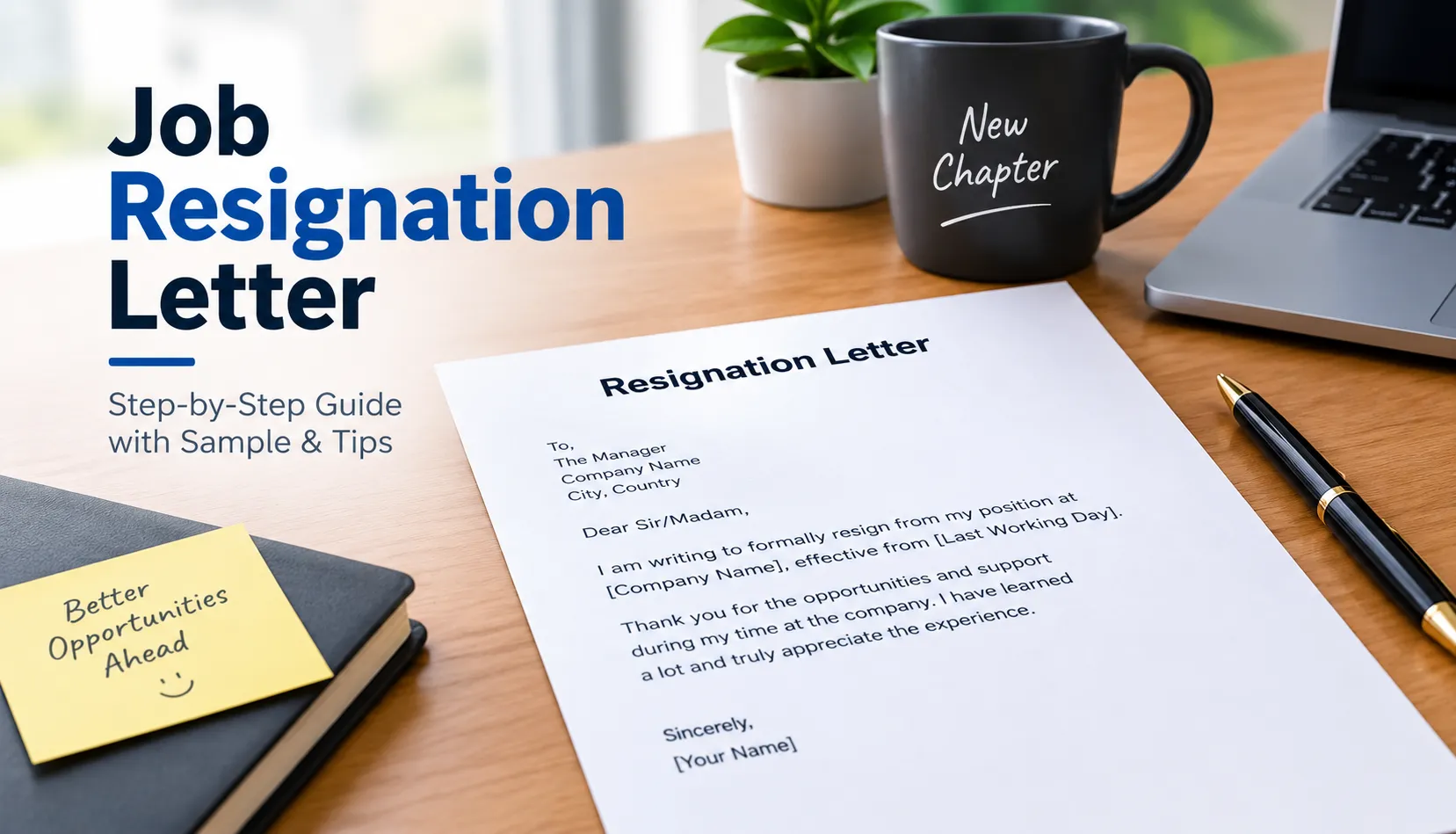
A Simple Job Resignation Letter Sample
Dear [Manager’s Name],
I am writing to formally resign from my position as [Job Title] at [Company Name]. My last working day will be [Date], in line with my notice period.
Thank you for the opportunities and support I’ve had during my time here. I’m happy to help hand over my work so the transition goes smoothly.
Sincerely,
[Your Name]
Change the details, match the tone to your workplace, and send it.
Types of Job Resignation Letters
The right letter depends on your situation. Use this table to find yours.
| Type | Best For | What Makes It Different |
| Standard letter | Leaving on good terms | Neutral tone, normal notice period |
| Two weeks’ notice | Many private-sector roles | States the two-week timeline up front |
| Immediate resignation | Emergencies or contract exits | Mentions leaving without notice or a buyout |
| Email resignation | Remote or hybrid teams | Shorter, with the letter as the email body |
| Retirement letter | Ending a career | Mentions your retirement date and years of service |
| Personal reasons | Health, family, or relocation | Keeps the reason general; see the personal reason resignation letter format |
Resignation Letters in Other Languages
Sometimes a letter in your local language fits better. If you work in a Hindi-speaking office, the resignation letter in Hindi guide has ready samples. For Karnataka, try the Kannada resignation letter, and for South Korea, the Korean letter of resignation explains the 사직서 format.
Common Mistakes to Avoid
- Venting: Save complaints for the exit interview, or skip them.
- Forgetting the last working day: It’s the most important line in the letter.
- Over-explaining: One line of reasoning is plenty.
- Skipping your contract: Check your notice period before you write anything.
- Not keeping a copy: Save a signed copy or the sent email.
- Sounding too casual: Stay professional, even if your team is relaxed.
Typical Notice Periods
Your contract always comes first, but these ranges are common.
| Role Level | Usual Notice | Note |
| Entry-level | 15-30 days | Often negotiable |
| Mid-level | 30 days | Standard in most private companies |
| Senior or manager | 30-60 days | Longer handover expected |
| Executive | 60-90 days | Clients or boards may need time |
| Government | 30-90 days | Depends on service rules |
| Probation | 1-15 days | Check your offer letter |
If you can’t serve the full period, talk to HR before you submit the letter. The letter itself isn’t the place to negotiate.
Browse More Resignation Letter Resources
You can explore every guide by category: Resignation Letters, Free Templates, and Examples. New posts also appear on the blog. If you have a question we haven’t covered, you can contact us or read more about the site.
Frequently Asked Questions
- Do I have to give a reason in my job resignation letter?
No. “For personal reasons” is fine, and so is leaving the reason out completely. - How much notice should I give?
Check your offer letter first. Most companies expect 15 to 30 days, and senior roles can require 60 to 90. - Can I send my resignation by email?
Yes, most employers accept it, especially for remote roles. Include the same details as a printed letter: that you’re resigning, your last working day, and your name. - Should I mention my new job?
It isn’t necessary, and it’s usually better not to. Keep the letter about leaving. - What if I can’t serve my full notice period?
Speak to HR about early release or a buyout before you hand in the letter. - Do I need to thank my employer if I disliked the job?
Not at all. A short, neutral line costs nothing and helps with references, but you can leave it out if it feels dishonest. - What’s the difference between a resignation letter and a relieving letter?
You write the resignation letter to say you’re leaving. The company issues the relieving letter afterward to confirm your last day and your release from duties.
Conclusion
A good job resignation letter is short, clear, and polite. State that you’re leaving, give the correct last working day, offer help with the handover, and sign off professionally. Pick the format that matches your situation, check your notice period, and keep a copy for yourself. With the sample and tables above, you can have a letter ready to send in a few minutes.