
If you’re searching for a simple resignation letter sample, you probably want to quit without drama and without spending an hour on the wording. Good news: a resignation letter is one of the shortest professional documents you’ll ever write. Four or five sentences is enough.
This page gives you ready-to-copy samples, a quick format, the mistakes that cause trouble, and answers to common questions. Pick the sample that fits your situation, fill in the blanks, and send it.
What Makes a Resignation Letter “Simple”?
A simple resignation letter says three things: you are leaving, your last working day, and (optionally) a short thank you. That’s it. You don’t need to explain your reasons, describe your next job, or list what you learned over the years.
Most employers only need the letter for their records. HR uses it to calculate your notice period, process your final settlement, and issue your relieving letter. So the clearer and shorter it is, the easier everyone’s job becomes.
If you want the full background on structure and tone, our guide to the resignation letter covers it in more depth.
Simple Resignation Letter Sample (Copy and Paste)
Here is the standard version most people use. It works for almost any private-sector job.
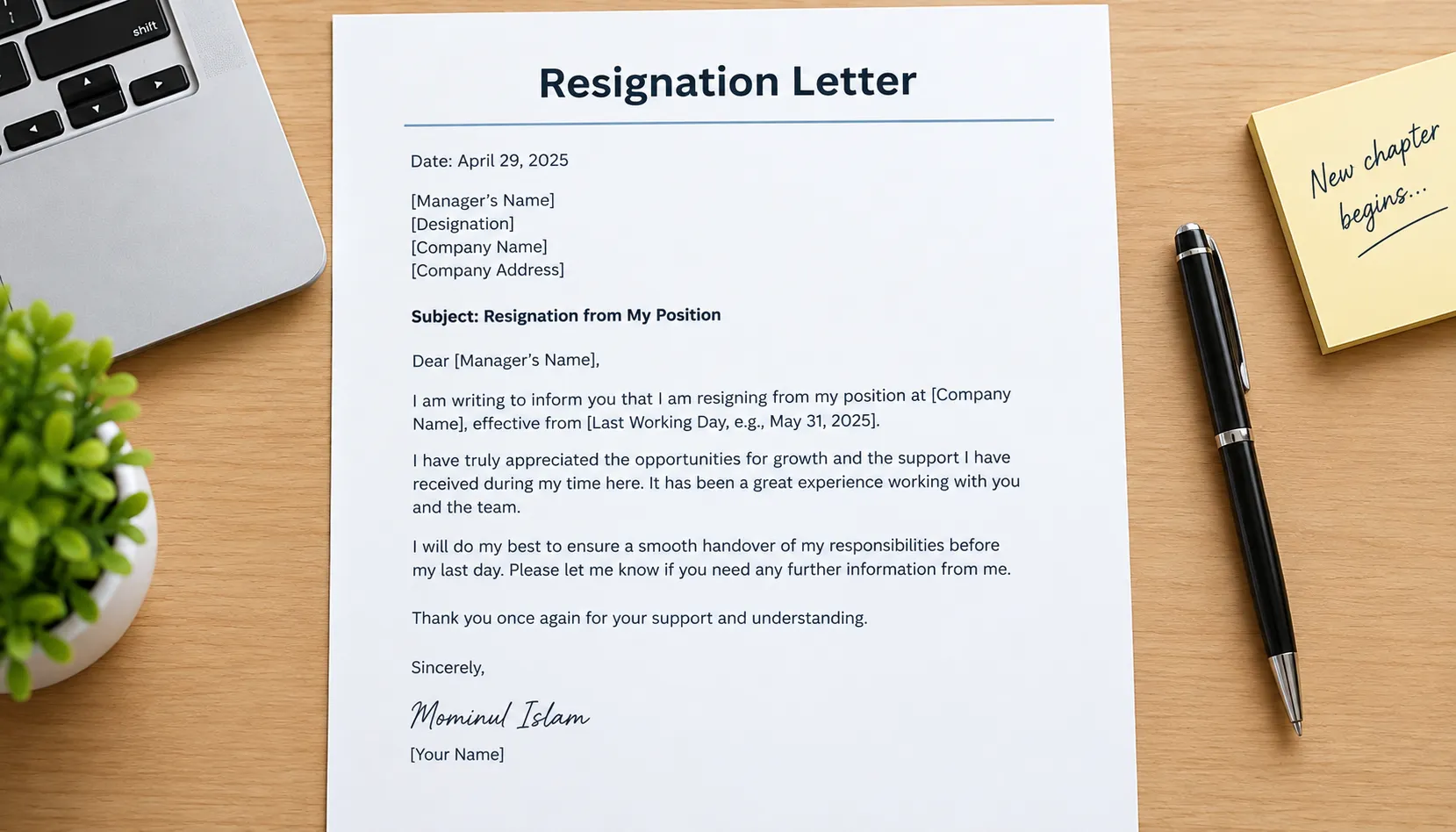
Dear [Manager’s Name],
I am writing to resign from my position as [Job Title] at [Company Name]. My last working day will be [Date], in line with my notice period.
Thank you for the opportunities and support during my time here. I’m happy to help with the handover so the transition goes smoothly.
Sincerely,
[Your Full Name]
[Employee ID, if applicable]
Replace the brackets, check your notice period in your contract, and you’re done. If you want more variations with different tones, browse our collection of free resignation letter templates.
Simple One-Line Resignation Letter Sample
Some workplaces are informal, and a long letter would feel odd. In that case, this works:
Dear [Manager’s Name], please accept this as my resignation from the position of [Job Title], effective [Last Working Day]. Thank you for the opportunity. Regards, [Your Name]
Use this only when your company culture is relaxed and your manager already knows you’re leaving. If HR needs a formal record, go with the standard sample above.
Simple Resignation Letter Sample for Personal Reasons
You never have to explain why you’re leaving. If you’d like to mention a reason without going into detail, keep it general:
Dear [Manager’s Name],
I am resigning from my role as [Job Title] at [Company Name] for personal reasons, effective [Last Working Day].
I appreciate the support I’ve received here and will do my best to hand over my work before I leave.
Sincerely,
[Your Name]
“Personal reasons” is accepted almost everywhere and rarely invites follow-up questions.
Simple Resignation Email Sample
Many teams now accept resignations by email, especially remote and hybrid ones. Here’s a short version:
Subject: Resignation – [Your Name]
Dear [Manager’s Name],
Please accept this email as my formal resignation from the position of [Job Title], effective [Last Working Day].
Thank you for the opportunity to work with the team. I’ll make sure my tasks are handed over properly before I go.
Best regards,
[Your Name]
If you’re resigning from a regular job and want a version tailored to that situation, see our job resignation letter page. For contract-based or salaried roles, the employment resignation letter guide is a better fit.
Which Simple Resignation Letter Sample Should You Use?
Not sure which version to pick? This table makes the choice quick.
| Sample Type | Best For | Approx. Length |
| Standard simple letter | Most jobs, formal workplaces | 60 to 80 words |
| One-line letter | Informal teams, small businesses | 20 to 30 words |
| Personal reasons letter | When you’d rather not explain | 50 to 70 words |
| Resignation email | Remote or hybrid roles | 50 to 70 words |
| Letter with handover offer | Senior or specialised roles | 80 to 100 words |
If none of these match your case, our resignation letters category has formats for other situations, and the examples section shows how real letters are worded.
How to Write a Simple Resignation Letter in 5 Steps
You don’t need a template to write one. Follow this order and you’ll have a clean letter in about five minutes.
- State that you’re resigning: Put it in the first sentence. Don’t hide it in the second paragraph.
- Give your last working day: Check your contract first. Notice periods are commonly 15, 30, or 60 days.
- Add one line of thanks: Keep it short and genuine. If the job was rough, a generic “thank you for the opportunity” is fine.
- Offer help with the handover: One sentence is enough.
- Sign off formally: Use your full name, and add your designation or employee ID if your company asks for it.
What to Include (and Skip) in a Simple Resignation Letter
Include:
- Your name and job title
- The company name
- The date you’re submitting the letter
- Your last working day
- A short thank you
Skip:
- Complaints about your manager, team, or pay
- Details about your next job
- Long explanations of why you’re leaving
- Anything you’d be uncomfortable seeing in your HR file years from now
Short letters age well. Long ones tend to include something you regret.
Common Mistakes to Avoid
Most problems with resignation letters come from a few repeat errors:
- Leaving out the last working day: This is the detail HR needs most.
- Ignoring your notice period: Read your offer letter before you pick a date. A wrong date can delay your final payment.
- Writing while angry: Even if you’re leaving a bad situation, keep the letter neutral. You can raise concerns in an exit interview if you want to.
- Forgetting to keep a copy: Save a signed copy, or keep the sent email, for your own records.
- Being too casual: Even a simple letter should sound professional. Save the jokes for your farewell message to the team.
Notice Period Guide
Your contract always decides, but these are typical ranges:
| Role Level | Typical Notice Period |
| Entry-level | 15 to 30 days |
| Mid-level | 30 days |
| Senior or managerial | 30 to 60 days |
| Executive | 60 to 90 days |
| Probation period | 1 to 15 days |
If you can’t serve the full notice, talk to HR before you submit the letter. The letter itself isn’t the place to negotiate.
Where to Find More Samples
This page covers the basics, but different situations call for different wording. You can explore more formats on the resignationletter.in homepage, read practical advice on the blog, or learn more about the site on the About page. If you can’t find the sample you need, send us a note through the Contact page and we’ll look into adding it.
Frequently Asked Questions
- How long should a simple resignation letter be?
Between 50 and 100 words is plenty. Anything longer usually adds details your employer doesn’t need. - Do I need to give a reason in a simple resignation letter?
No. You can leave the reason out or say “for personal reasons.” Neither one is unusual. - Can I send a simple resignation letter by email?
Yes, in most companies. Use a clear subject line, include your last working day, and keep a copy of the sent email. - Should I print and sign the letter?
If your company asks for a hard copy, yes. Otherwise, a signed PDF or an email is usually accepted. - Who should I address the letter to?
Address it to your direct manager, and copy HR if that’s your company’s process. - What if my manager asks me to stay?
You can talk it over, but your letter still stands as written. If you change your mind, ask HR in writing to withdraw it. - Is a one-line resignation letter acceptable?
In informal workplaces, yes. In formal or large companies, use the standard sample so HR has a complete record. - What’s the difference between a resignation letter and a relieving letter?
You write the resignation letter to announce you’re leaving. The company issues the relieving letter afterward to confirm you’ve been released from your duties.
Conclusion
A simple resignation letter sample works because it stays focused: you’re leaving, here’s your last day, thank you. Everything else is optional. Pick the version that matches your workplace, check your notice period, keep a copy, and send it with confidence.
If you need a different format, explore the free templates and examples on this site, and you’ll find one that fits.