
A resignation letter for teacher roles is a short, formal note that tells your school or college you’re leaving, names your last working day, and gives the management time to find your replacement. It rarely takes more than 150 words. Even so, it matters a lot in teaching, where your principal’s goodwill, your experience certificate and your reference for the next school often depend on how you exit.
This guide covers what to include, a clean format, three ready samples, the mistakes teachers make most often, and answers to common questions. If you want the general version first, our guide on how to write a resignation letter is a good starting point.
What Is a Resignation Letter for Teacher Jobs?
It is a written notice you give your principal, headmaster, head of department or school management to confirm that you are ending your employment. It is dated, signed and addressed to the right authority.
Teaching jobs differ from most office jobs in one way: the academic calendar. Your replacement has to be hired, a syllabus has to be handed over, and students shouldn’t lose weeks of teaching in the middle of a term. That is why schools care so much about the timing and tone of your letter, sometimes more than the reason you’re leaving.
Why a Written Resignation Matters for Teachers
Telling the principal in person is polite, but it isn’t enough. A written letter does several jobs:
- It starts your notice period officially, so there’s no argument later about your last day.
- It is usually needed before the school releases your relieving letter and experience certificate.
- It supports your final settlement, including pending salary and leave encashment.
- It keeps your record clean when your next school asks for a reference.
Many schools won’t process your exit until a signed copy is on file. So it’s worth five minutes to get it right.
Check Your Notice Period First
Before you write anything, read your appointment letter. Private schools often ask for one to three months’ notice, and some prefer you to leave at the end of a term or session. Government and aided institutions follow service rules, which can be different again.
If you can’t serve the full period, talk to the principal or HR before submitting the letter. The letter itself is not the place to negotiate.
How to Write a Resignation Letter for Teacher Positions
The structure is the same as any resignation, with a few teacher-specific touches. You can see the general layout in our resignation letter format page. For teachers, follow these steps:
- Address it correctly: Use the principal’s or headmaster’s name and designation, plus the school’s name.
- Add a clear subject line: “Resignation from the post of [Subject] Teacher” works well.
- State your decision in the first sentence: Don’t make the reader hunt for it.
- Give your last working day: Calculate it from your notice period or the end of the term.
- Say thank you: One honest line about the school, the students or your colleagues is enough.
- Offer a handover: Mention lesson plans, records, marks and any class-teacher duties you’ll pass on.
- Sign off politely: Add your name, designation and employee ID if you have one.
Resignation Letter Format for Teachers
| Section | What to write | Length |
| Date and address | Today’s date, principal’s name, school name and address | 3 to 4 lines |
| Subject line | Resignation from the post of [Subject] Teacher | 1 line |
| Salutation | Respected Sir/Madam or Dear [Principal’s Name] | 1 line |
| Opening | A clear statement that you are resigning from your post | 1 to 2 sentences |
| Last working day | The exact date, based on your notice period | 1 sentence |
| Thanks | Brief appreciation for the school and students | 1 to 2 sentences |
| Handover | Offer to hand over classes, records and responsibilities | 1 sentence |
| Closing | Yours sincerely, your name, designation and signature | 3 lines |
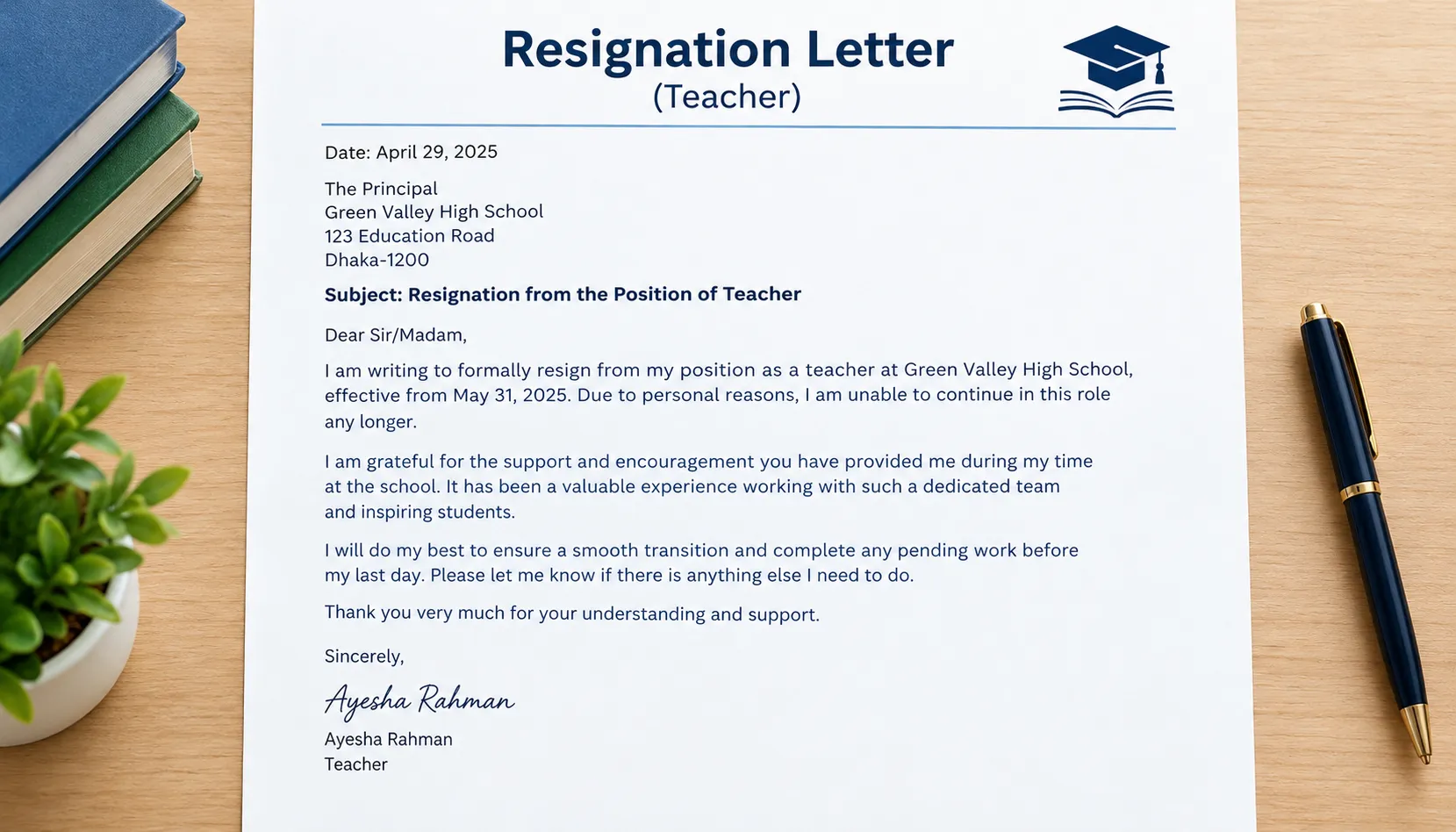
Resignation Letter for Teacher: Sample 1 (Standard)
To,
The Principal,
[School Name],
[City]
Date: [Date]
Subject: Resignation from the post of [Subject] Teacher
Respected Sir/Madam,
I am writing to resign from my position as [Subject] Teacher at [School Name]. As per my notice period, my last working day will be [Date].
Working with the students and staff here has taught me a great deal, and I am thankful for the support I received. I will gladly help with handing over my classes, lesson plans and records so that teaching continues smoothly.
Thank you for the opportunity.
Yours sincerely,
[Your Name]
[Designation and Employee ID]
Sample 2: Resignation Letter for a Teacher Leaving for Personal Reasons
Sometimes you don’t want to explain much, and you don’t have to. If you’d like more wording ideas, the personal reason resignation letter format guide has several versions.
Respected Madam,
I am submitting my resignation from the post of [Subject] Teacher, effective [Date], due to personal reasons. I regret any inconvenience this may cause and will make sure my classes and records are handed over properly before I leave.
I am grateful for the guidance and encouragement I received during my time at [School Name].
Yours sincerely,
[Your Name]
Sample 3: Resignation Letter for a Teacher Moving to a New Job or City
Dear [Principal’s Name],
Please accept this letter as my formal resignation from the position of [Subject] Teacher at [School Name]. I have accepted a new opportunity [or: I am relocating to a new city], and my last working day will be [Date].
Thank you for trusting me with my classes and for the support from you and my colleagues. I will complete my assessment work and share all my lesson material before I go.
Sincerely,
[Your Name]
How to Phrase Your Reason for Leaving
You aren’t required to give a reason. If you do, keep it to one line. Here is how common situations can be worded:
| Situation | Suggested wording |
| Better opportunity | “I have accepted another position and wish to move on.” |
| Relocation | “I am relocating to another city with my family.” |
| Higher studies | “I have decided to pursue further studies.” |
| Health or family | “I am resigning due to personal reasons.” |
| Career change | “I have decided to take my career in a different direction.” |
| Retirement | “I wish to retire from service with effect from [Date].” |
Common Mistakes Teachers Make
Most problems come from a handful of habits:
- Resigning without reading the contract: Notice terms and bond clauses can cost you money if you miss them.
- Leaving mid-term without warning: It hurts students, and it’s remembered by the next school’s staff, because teaching circles are small.
- Venting in the letter: If you have complaints, save them for the exit conversation. The letter stays in your file.
- Forgetting the last working day: It’s the one detail HR needs most.
- Not keeping a copy: Get a signed acknowledgment, or send an email copy as well.
Resignation Letter by Email
Many schools now accept resignation by email. Keep the subject line clear, such as “Resignation: [Your Name], [Subject] Teacher”, paste the letter in the body, and attach a signed PDF if the school asks for one. For a more general look at the written version, see our employment resignation letter page, or the job resignation letter guide if you want a template for any workplace.
If your principal or management prefers another language, we also have a resignation letter in Hindi and a Kannada resignation letter you can adapt. Teachers working abroad may find the Korean letter of resignation page useful too.
After You Submit the Letter
Submitting is only half the work. In the weeks that follow:
- Hand over syllabus progress, marks, attendance registers and any exam duties in writing.
- Keep teaching properly until your last day. Your final impression counts.
- Collect your relieving letter, experience certificate and any pending dues before you leave.
- Say goodbye to students and colleagues kindly. References often come from people you didn’t expect.
Browse the resignation letters, free templates and examples sections for more formats, or the blog for newer guides. If you have a question we haven’t covered, you can contact us.
Frequently Asked Questions
- Do I have to give a reason in my resignation letter for teacher jobs?
No. You can say “personal reasons” or leave the reason out. One short line is plenty if you do mention it.
- How much notice should a teacher give?
It depends on your contract. Many private schools expect one to three months, and some prefer you to leave at the end of a term. Check your appointment letter before you decide on a date.
- Can I send my resignation by email?
Usually yes. Include the same details as a printed letter, and ask for a written acknowledgment so you have proof of the date.
- Who should I address the letter to?
Address it to the principal or headmaster, and mark a copy to the HR or management office if your school has one. In colleges, the head of department or director may also need a copy.
- Can I resign in the middle of the academic session?
You can, but it is harder on the school and the students. If you must, give as much notice as possible and offer a thorough handover. Some schools also ask for a notice buyout.
- Will a resignation letter affect my experience certificate?
A polite, properly timed letter helps you. Schools generally release the relieving letter and experience certificate once the notice period is served and the handover is done.
- Should I mention my new school in the letter?
It isn’t necessary. Keep the letter about leaving your current role and share new job details only if someone asks.
Conclusion
A good resignation letter for teacher roles is short, polite and specific. State that you are resigning, give your last working day, say thanks, and offer a proper handover. Check your notice period first, keep a signed copy, and stay professional until your final day.
Use the samples above as a starting point, change the details to match your school, and you’ll have a letter ready in minutes. A clean exit protects your reputation, and in teaching, reputation travels.