
If you need a resign letter in English, the good news is that it takes about five minutes once you know the structure. A resign letter is a short, formal note that tells your employer you are leaving, gives your last working day, and keeps your exit on record. It does not need fancy words. Plain, polite English is what HR teams prefer.
This guide covers the format, a step-by-step method, three ready samples, useful phrases, common mistakes, and answers to the questions people ask most.
What Is a Resign Letter in English?
A resign letter in English is a written notice, usually addressed to your manager or HR, saying you are ending your employment. Most are between 100 and 200 words. It is dated, signed, and kept to the point.
Many people write it in English even when they work in a company where the team speaks Hindi, Bengali, or another language. English is the default for official HR records, and a future employer who calls for a reference will usually see this document first. If you want a very short version, the simple resignation letter sample page has one you can copy as it is.
When Do You Need a Written Resign Letter?
A quick chat with your manager is a good first step, but it should never be the only step. Here is why the written letter matters:
- It proves the date: A dated letter settles any argument about your last working day.
- It starts your notice period: Most contracts count notice from the day you submit the letter.
- It speeds up your final settlement: Many companies will not release your final pay, experience letter, or relieving letter without it.
- It protects your reputation: A calm, polite letter is remembered. An angry exit is remembered more.
Resign Letter Format in English
Almost every resign letter follows the same skeleton, whether you work in a private company, a school, or a government office.
| Section | What to write | Length |
| Date and address | Today’s date, manager’s name, designation, company name | 2 to 3 lines |
| Subject line | “Resignation Letter: [Your Name]” | 1 line |
| Salutation | “Dear [Manager’s Name],” | 1 line |
| Opening | A clear statement that you are resigning from your post | 1 to 2 sentences |
| Last working day | The exact date, based on your notice period | 1 sentence |
| Thanks (optional) | A short thank you for the opportunity | 1 to 2 sentences |
| Handover offer | Willingness to help the team after you leave | 1 sentence |
| Closing | “Sincerely” or “Regards,” plus your name and signature | 2 to 3 lines |
If you plan to type and print the letter, the resignation letter format Word page explains the margins, font, and spacing that look neat on paper.
How to Write a Resign Letter in English, Step by Step
- State your decision in the first line: Do not make your manager read three sentences to find out what the letter is about.
- Add your last working day: Check your offer letter first. Notice periods of 15, 30, or 60 days are common.
- Say thank you, if you mean it: One honest line is enough.
- Offer help with the handover: Mention that you will finish pending tasks or train a colleague.
- Skip the long reasons: “For personal reasons” is an acceptable and complete answer.
- Sign off politely and keep a copy: Save a signed copy or a sent email for your own records.
Three Resign Letter Samples in English
1. Standard Resign Letter
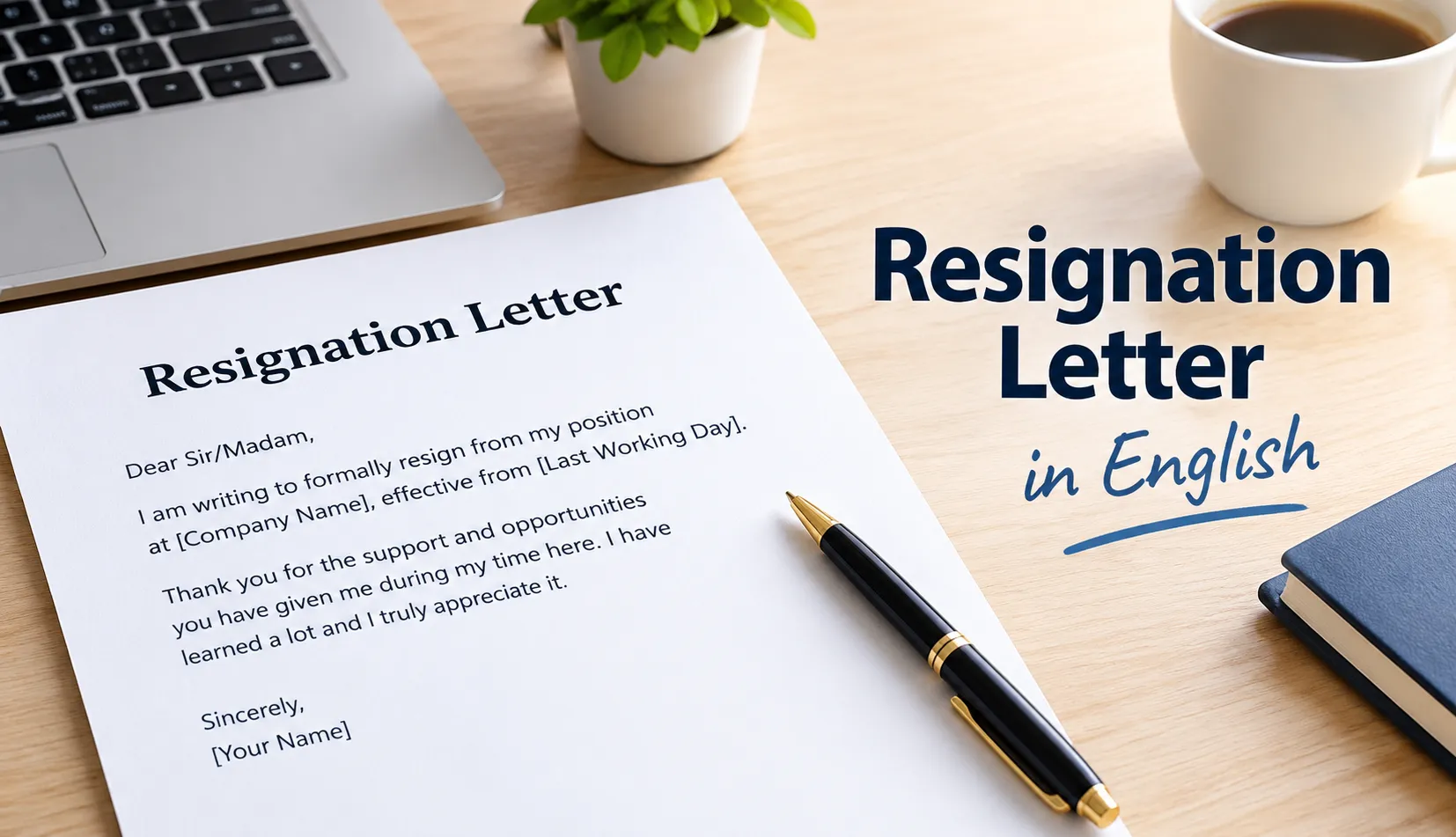
Dear [Manager’s Name],
I am writing to resign from my position as [Job Title] at [Company Name]. My last working day will be [Date], in line with my notice period.
Thank you for the support and the opportunities I have had here. I will complete my pending work and help hand over my duties before I leave.
Sincerely,
[Your Name]
2. Resign Letter by Email
Subject: Resignation: [Your Name], [Job Title]
Dear [Manager’s Name],
Please accept this email as my formal resignation from the post of [Job Title], effective [Date]. I am happy to support the handover in the coming weeks.
Thank you for everything.
Regards,
[Your Name]
3. Resign Letter for Personal Reasons
Dear [Manager’s Name],
I regret to inform you that I have decided to resign from my role as [Job Title] for personal reasons. My last working day will be [Date].
I appreciate the time I have spent with the team and will make the transition as smooth as possible.
Yours sincerely,
[Your Name]
Working in a school or college? A teacher’s letter usually mentions classes, students, and the academic term, which is covered in detail in this resignation letter for teacher guide.
Useful English Phrases for Your Resign Letter
You do not need advanced vocabulary. These simple lines work in nearly every workplace.
| Purpose | Phrase you can use |
| Announcing your decision | “I am writing to formally resign from my position as…” |
| Giving the date | “My last working day will be…” |
| Showing thanks | “I am grateful for the opportunities I have had here.” |
| Offering help | “I will do my best to ensure a smooth handover.” |
| Keeping the reason private | “I have decided to move on for personal reasons.” |
| Closing politely | “Thank you for your support and guidance.” |
Common Mistakes to Avoid
- Writing when you are angry: Cool down first. A letter written in anger cannot be unsent.
- Forgetting the last working day: This is the one detail HR really needs.
- Writing too much: A full page of explanation is rarely a good idea.
- Ignoring your contract: If you miss the notice period, you may lose pay or your relieving letter.
- Using slang or text language: Keep the tone professional even if your workplace is relaxed.
- Not keeping a copy: You may need proof later for a new job or a legal question.
Where to Find More Templates
If you want a different style or a layout for your own job type, browse the resignation letters category for ready formats. You can also pick from the free resignation letter templates and compare real resignation letter examples before you write yours. For tips on notice periods, handovers, and exit interviews, the blog has more guides.
Frequently Asked Questions
- What is the best way to start a resign letter in English?
Start with one clear sentence, such as “I am writing to formally resign from my position as [Job Title].” Put your decision first and the details after it. - Do I have to give a reason in my resign letter?
No. You can say “for personal reasons” or leave the reason out. Most employers do not expect a long explanation. - How long should a resign letter be?
Between 100 and 200 words is enough. Three short paragraphs cover everything HR needs. - Can I send my resign letter by email?
Yes, most companies accept it, especially for remote and hybrid jobs. Include your intent, last working day, and name, just as in a printed letter. If your company asks for a hard copy too, print and sign one. - How much notice should I give?
Check your contract. Many private companies ask for 30 days, while senior roles may need 60 or 90 days. Some entry-level jobs accept 15 days. - Should I thank my employer even if I was unhappy?
It is not compulsory. A short, neutral line of thanks keeps the door open for future references. If it feels dishonest, you can skip it. - What is the difference between a resign letter and a relieving letter?
You submit the resign letter to tell the company you are leaving. The company gives you the relieving letter afterward to confirm that you have been released from your duties.
Conclusion
A good resign letter in English is short, polite, and clear. State your decision, give your last working day, say a brief thank you, and offer help with the handover. That is all most employers need to process your exit smoothly.
Pick one of the samples above, replace the brackets with your details, and check your notice period before you send it. If you want a different layout, the simple resignation letter sample and the resignation letter format Word pages are good places to continue.