
Your resignation letter subject is the first thing your manager or HR sees, and it decides whether your email gets opened today or buried under 40 others. A good one is short, clear and boring in the best way. It tells the reader exactly what’s inside, so nothing gets missed and your exit starts on the right foot.
This guide covers what a resignation letter subject is, how to write one, 30+ lines you can copy, and the mistakes that make people regret their wording a week later.
What Is a Resignation Letter Subject?
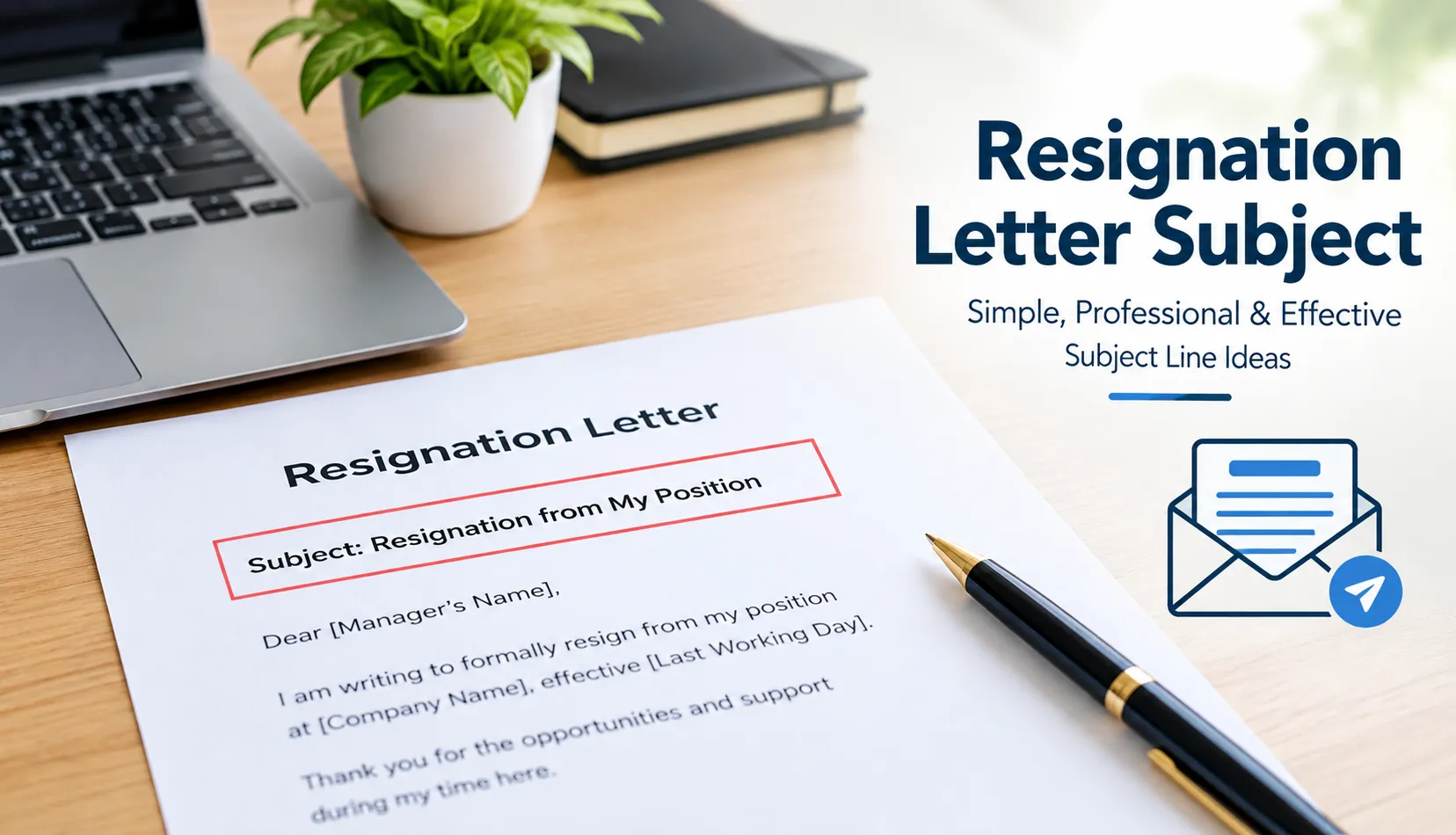
A resignation letter subject is the one-line heading that tells the reader what your email or letter is about. On email, it sits in the subject field. On a printed letter, it goes right below the salutation or the address block, usually starting with “Subject:” or “Sub:”.
It has one job: to say you are resigning. It doesn’t need to explain why, thank anyone or sound clever. Your manager should understand the whole message from that single line.
Why the Subject Line Matters More Than You Think
Most people spend ten minutes on the letter body and ten seconds on the subject. That’s backwards. Here is what a clear subject line does for you:
- It gets opened: Managers skim. “Resignation” in the subject tells them this one can’t wait.
- It creates a record: HR often searches mailboxes for “resignation” when processing a final settlement. A vague subject like “Hello” or “Quick note” makes that harder.
- It protects your date: If the subject includes your last working day, nobody can later claim they didn’t know it.
- It sets the tone: A calm, professional line signals that you’re leaving properly, which helps with references later.
How to Write a Resignation Letter Subject (Step by Step)
You don’t need creativity here. Follow this order and you’ll have a good subject in under a minute.
- Start with the word “Resignation:” Put it first so it shows up in the inbox preview, even on a small phone screen.
- Add your name: “Resignation – Priya Sharma” lets HR file it without opening it.
- Add your designation if your company is large: When hundreds of people share a first name, the job title helps.
- Include your last working day if you want to be extra clear: This is optional, but it works well for formal or contract-heavy workplaces.
- Keep it under about 60 characters: Longer subject lines get cut off on mobile.
- Check the spelling of your own name: Sounds silly, happens often.
If you also need the body of the letter, our guide on how to write a resignation letter walks through each paragraph, and the resignation letter format page shows where the subject line sits on the page.
Resignation Letter Subject Examples by Situation
Different situations call for slightly different wording. Here are lines you can copy and adjust.
Standard Resignation (Good Terms)
| Subject Line | Best For |
| Resignation – [Your Name] | Any normal job exit |
| Letter of Resignation – [Your Name], [Job Title] | Larger companies |
| Resignation Notice – [Your Name] | Simple, neutral tone |
| Formal Resignation – [Your Name] | Corporate and government roles |
| Resignation from the Position of [Job Title] | Printed letters |
With Last Working Day Included
| Subject Line | Best For |
| Resignation – [Your Name], Last Working Day [Date] | When the date must be unmistakable |
| Resignation Effective [Date] – [Your Name] | Strict notice period clauses |
| Notice of Resignation: Final Day [Date] | Handover-heavy roles |
| Resignation with 30 Days’ Notice – [Your Name] | When you want the notice length visible |
Two Weeks’ Notice
| Subject Line | Best For |
| Two Weeks’ Notice – [Your Name] | US-style private sector jobs |
| Resignation: Two Weeks’ Notice from [Your Name] | Slightly more formal version |
| Notice of Resignation (Two Weeks) – [Your Name] | When HR is copied in |
Personal Reasons
| Subject Line | Best For |
| Resignation Due to Personal Reasons – [Your Name] | Health, family or relocation |
| Resignation – [Your Name] (Personal Reasons) | When you want to keep it short |
| Letter of Resignation – Personal Reasons | Printed letters |
If you’re leaving for something you’d rather not detail, the personal reason resignation letter format page shows how to word the whole letter without over-explaining.
Immediate or Short Notice
| Subject Line | Best For |
| Immediate Resignation – [Your Name] | Emergencies or buyout situations |
| Resignation Effective Immediately – [Your Name] | When your contract allows it |
| Request for Early Release – Resignation, [Your Name] | When you’re asking, not announcing |
Role-Specific Examples
| Subject Line | Best For |
| Resignation from Teaching Position – [Your Name] | Schools and colleges |
| Resignation – [Your Name], [Department] | Large teams with many departments |
| Resignation – [Your Name], [Employee ID] | Companies that file by employee number |
| Retirement Resignation – [Your Name] | Leaving after a long career |
Teachers can find a full sample in our resignation letter for teacher guide.
Very Short and Simple
| Subject Line | Best For |
| Resignation | Small teams, informal workplaces |
| My Resignation | Direct email to a close manager |
| Notice of Resignation | Anyone who wants the plainest line possible |
If your workplace is relaxed and you only need a few lines in the body, a simple resignation letter sample pairs well with these short subjects.
Email Subject vs. Printed Letter Subject
The same idea gets written slightly differently depending on where it appears.
| Feature | Email Subject Line | Printed Letter Subject |
| Where it goes | Subject field of the email | Below the salutation or address |
| Starts with “Subject:”? | No | Usually yes |
| Ideal length | Under 60 characters | One short line |
| Include your name? | Yes, helps with searching | Optional, your signature covers it |
| Include last working day? | Helpful | Optional |
| Example | Resignation – Amit Verma, Last Day 15 Nov | Subject: Resignation from the post of Sales Executive |
If you’re working in a document, our free resignation letter format Word template already has a subject line placed where it should be.
What to Avoid in Your Resignation Letter Subject
Most bad subject lines fail in the same few ways.
| Mistake | Why It Hurts | Better Option |
| “Important!!!” or “URGENT” | Looks dramatic, sets a bad tone | “Resignation – [Your Name]” |
| “I quit” | Too blunt, reads as angry | “Notice of Resignation” |
| Leaving it blank | May land in spam or get ignored | Always write one |
| Writing the whole reason in the subject | Over-explains and invites questions | Keep reasons in the body, or skip them |
| Reusing an old email thread (“Re: Meeting notes”) | Gets lost, looks careless | Start a fresh email |
| Putting your next employer’s name in it | Unnecessary and awkward | Leave it out entirely |
| Emojis or slang | Unprofessional on a legal record | Plain text only |
One more thing worth saying: don’t send your resignation from a thread your whole team is on. Start a new email, address it to your manager, and copy HR if that’s your company’s process.
Who Should You Address It To?
The subject line works together with the recipient line. In most companies, you send the resignation to your direct manager first and copy HR. In some organisations, HR wants the letter before anyone else, so check your employee handbook if you’re unsure. Either way, your subject should read the same.
A Quick Example Email (Subject + Body)
Subject: Resignation – Neha Kapoor, Marketing Executive
Dear Mr. Rao,
Please accept this email as my formal resignation from the post of Marketing Executive at [Company Name]. As per my notice period, my last working day will be 15 November.
Thank you for the support and the opportunities I’ve had here. I’m happy to help with a smooth handover over the next few weeks.
Regards,
Neha Kapoor
Looking for more complete templates? Browse our free templates collection, or read the full job resignation letter guide for sample bodies that match these subject lines.
Frequently Asked Questions
- What should I write in the subject line of a resignation email?
Write “Resignation” followed by your name, such as “Resignation – Rahul Mehta.” Add your job title or last working day if your company is large or strict about dates.
- Is a subject line necessary in a resignation letter?
For email, yes, always. For a printed letter, it isn’t mandatory, but it’s standard practice in many offices, especially in India, and it makes the letter easier to file.
- Should I mention my last working day in the subject?
It’s optional. It helps when your notice period is contested or when HR needs the date quickly. If your relationship with your manager is easy, “Resignation – [Your Name]” is enough.
- Can I use “Subject: Resignation” with nothing else?
You can. It’s accepted in informal workplaces and small teams. In bigger companies, adding your name makes it easier to find later.
- How long should a resignation letter subject be?
Aim for under 60 characters. Shorter is better, since long subjects get cut off in many inboxes, especially on phones.
- Should I put the reason for leaving in the subject line?
No. Keep the reason, if you give one at all, inside the letter. Subjects like “Resignation Due to Personal Reasons” are fine because they stay general, but detailed explanations don’t belong there.
- What is a good subject line for a two weeks’ notice email?
“Two Weeks’ Notice – [Your Name]” is the clearest option. It states the notice length straight away.
- Can I send my resignation without a subject line?
It’s better not to. A blank subject can look like a mistake, may trigger spam filters, and makes your resignation harder to find in an HR search later.
- Do I need a different subject for an immediate resignation?
Yes. Use something like “Immediate Resignation – [Your Name]” so the reader knows right away that normal notice terms may not apply. Check your contract first, since leaving without notice can affect your final settlement.
Conclusion
The best resignation letter subject is the one nobody has to think about: “Resignation – [Your Name],” maybe with a job title or last working day added. It’s clear, searchable and professional, which is all you need from it.
Pick one line from the tables above, pair it with a short, polite letter body, and send it from a fresh email. If you want the rest of the letter done in minutes, start with our resignation letter format guide or visit the Resignation Letter homepage for more samples and templates.