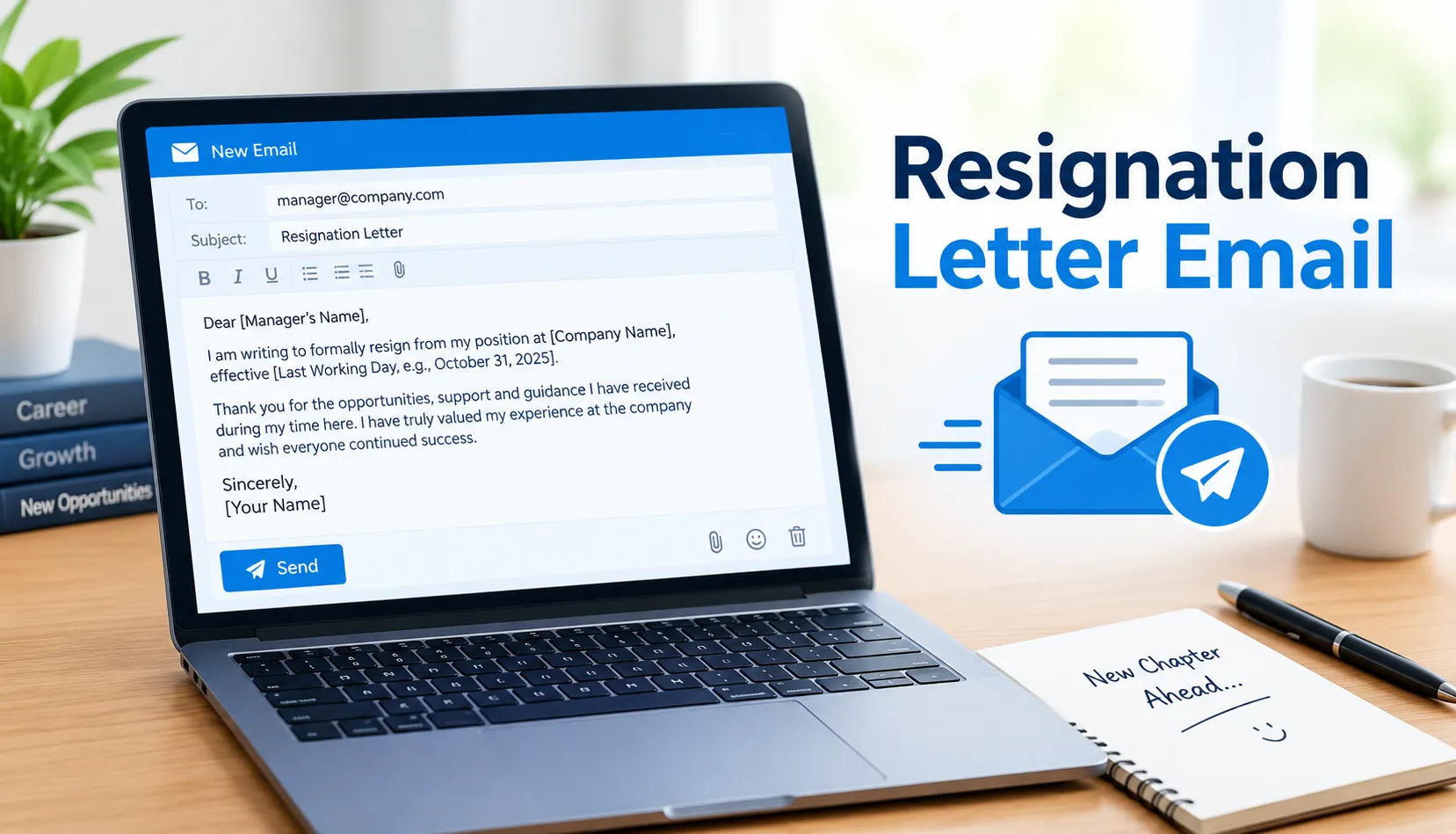

A resignation letter email is a short, formal email that tells your employer you are leaving, states your last working day, and can include a line of thanks. Send it to your manager, copy HR if your company asks for that, and keep it between 80 and 150 words. This guide gives you copy-and-paste samples, subject lines, and a simple format that works for most workplaces.
If you want the quick version, jump to the short resignation letter or the simple resignation letter sample. For the full picture, keep reading.
What Is a Resignation Letter Email?
A resignation letter email is your written notice of resignation, sent by email instead of printed and handed over. It does the same job as a paper letter. It names your role, gives your last working day, and creates a dated record.
Most modern workplaces accept it, especially remote and hybrid teams. Some government offices, schools, and old-school companies still want a signed paper copy as well. If you’re unsure, ask HR. It takes ten seconds and saves a headache later.
Can You Resign by Email?
Yes, in most private-sector jobs. An email is timestamped, easy to forward to HR, and easy to keep. That makes it a perfectly valid way to give notice.
There is one rule I’d follow. Talk to your manager first if you can, even for two minutes. Then send the email the same day. A manager who hears the news from you, and then sees it in writing, rarely feels blindsided. Check your contract too, because a few employers require notice “in writing, signed.”
Resignation Letter Email Format
The email format is the standard resignation letter format with a subject line on top and less address clutter. This table shows every part.
| Part of the email | What to write | Length |
| Subject line | “Resignation: [Your Name], [Job Title]” | 1 line |
| Greeting | “Dear [Manager’s Name],” | 1 line |
| Opening statement | A plain sentence saying you are resigning | 1 sentence |
| Last working day | The exact date, based on your notice period | 1 sentence |
| Thanks (optional) | A short, honest thank-you | 1-2 sentences |
| Handover offer | A line about helping with the transition | 1 sentence |
| Sign-off | “Regards,” your full name, phone number, employee ID if used | 2-4 lines |
If you prefer to draft in a document first, the resignation letter format Word page has an editable layout you can paste into your email.
Resignation Letter Email Subject Lines
Your subject line has one job: get opened and filed correctly. Keep it clear and boring. Clever subject lines don’t help here.
- Resignation: [Your Name], [Job Title]
- Resignation Notice: [Your Name]
- Notice of Resignation, Effective [Date]
- Formal Resignation from [Job Title]
Our resignation letter subject guide has more than 30 ready-to-use lines if you need other options.
Resignation Letter Email Sample (Professional)
Use this when you want a warm but businesslike tone. It suits most office jobs.
Subject: Resignation: [Your Name], [Job Title]
Dear [Manager’s Name],
Please accept this email as my formal resignation from the position of [Job Title] at [Company Name]. My last working day will be [Date], in line with my [30-day] notice period.
Thank you for the support and the opportunities I’ve had here. Over the next few weeks I will document my ongoing tasks and brief [colleague’s name] so the handover is smooth.
Please let me know if you need anything else from me before I leave.
Regards,
[Your Name]
[Phone number]
Short Resignation Letter Email Sample
Use this when you’ve already discussed your exit with your manager, or your workplace is informal. For more tone options, see the short resignation letter page.
Subject: Resignation: [Your Name]
Hi [Manager’s Name],
I am resigning from my position as [Job Title]. My last working day will be [Date]. Thank you for everything.
[Your Name]
Two Weeks’ Notice Email Sample
This one is common in the US and in roles with short notice periods. State the timeline in the first line so nobody has to count days.
Subject: Two Weeks’ Notice: [Your Name]
Dear [Manager’s Name],
Please consider this email my two weeks’ notice. I am resigning from my role as [Job Title], and my last day will be [Date].
I’ll finish my current projects and help hand over my work before I go. Thank you for the opportunity to work with you and the team.
Sincerely,
[Your Name]
You’ll find more wording for this situation in our guide to a resign letter in English.
Resignation Email for Personal Reasons
You don’t owe anyone a full explanation. One general line is enough, and it keeps things calm. Our personal reason resignation letter format page shows more ways to word it.
Subject: Resignation: [Your Name], [Job Title]
Dear [Manager’s Name],
I am resigning from my position as [Job Title] for personal reasons, effective [Date]. I appreciate your understanding and am happy to help with the handover during my notice period.
Regards,
[Your Name]
How to Write a Resignation Letter Email in 6 Steps
Here is the process in order. For a longer walkthrough, read how to write a resignation letter.
- Check your notice period in your offer letter or contract.
- Tell your manager in person or on a call, if possible.
- Write a clear subject line with your name and job title.
- State in the first sentence that you are resigning, then give your last working day.
- Add one line of thanks and a handover offer.
- Proofread, send, and keep a copy or screenshot of the sent email.
When to Send It and Who to Include
Timing and recipients matter more than most people think. This table covers the usual cases.
| Situation | Who to send it to | Extra step |
| Standard office job | Direct manager, HR in copy | Say it in person first |
| Remote team | Manager and HR | Book a short video call before sending |
| Government or public sector | Designated authority | Follow with a signed paper copy |
| Teaching job | Principal or head | See the resignation letter for teacher page |
| Probation period | Manager and HR | Check the shorter notice in your offer letter |
If you have a general question about your job exit, the job resignation letter and employment resignation letter pages cover the basics.
Mistakes to Avoid in a Resignation Email
Most weak resignation emails fail in the same few ways.
- Venting: Save complaints for the exit interview, or skip them. This email stays on file.
- Forgetting the last working day: It’s the most important detail in the message.
- Writing too much: One line of reason is plenty, and none is fine.
- Guessing the notice period: Read your contract first.
- Hitting “Reply All” by accident: Double-check the recipient list before you send.
- Using your personal tone with a work email: Even in a casual office, keep it polite and clear.
- Skipping a copy: Forward the email to yourself or take a screenshot.
What Happens After You Send It
Your manager or HR will usually reply to confirm your last working day. Some companies send a resignation acceptance letter as formal proof. After that, you complete the handover, return company property, and attend an exit interview if there is one. The company later issues your relieving letter and final settlement.
Why Use resignationletter.in
People usually need a resignation email at short notice. Here’s what you get on resignationletter.in:
- Ready-to-use samples for common situations, from one-liners to detailed letters.
- Plain-language tips on tone, so you know what suits your workplace.
- No sign-up. Copy, edit, and send.
Browse the Resignation Letters category, grab a layout from the free templates, or see more wording in the examples. You can also read the blog or contact us with a question we haven’t covered. Our page on how to write a resign letter has extra samples too.
Frequently Asked Questions About Resignation Letter Emails
- What is a resignation letter email?
It is a formal email that tells your employer you are leaving. It names your role, your last working day, and, optionally, a thank-you. - Is it okay to resign by email?
Yes, in most workplaces. Include the same details as a printed letter, and keep a copy of the sent message. If your contract asks for a signed paper letter, send that too. - What should the subject line of a resignation email say?
Keep it simple: “Resignation: [Your Name], [Job Title].” It’s clear, easy to search, and easy for HR to file. - How long should a resignation email be?
Between 80 and 150 words. A short version can be just three sentences. - Do I have to give a reason for leaving?
No. “For personal reasons” or no reason at all is acceptable. - Who should I send my resignation email to?
Send it to your direct manager. Copy HR if your company asks for that, and only include others if your policy requires it. - How much notice should I give?
Follow your contract. Many private employers expect 15 to 30 days, senior roles often need 60 to 90, and the US standard is often two weeks. - Should I mention my new job?
It’s not necessary. Most people leave it out unless the contract requires it. - Can I withdraw a resignation email after sending it?
Sometimes, but only if your employer agrees. Speak to your manager or HR directly and ask for the withdrawal in writing.
Conclusion
A good resignation letter email is short, clear, and polite. It names your role, gives the right last working day, and leaves a clean record behind you. Whether you need a professional email, a two-weeks’ notice, or a three-line message, the structure barely changes.
Start with a sample above, check your notice period, and send it. If your situation is more specific, explore our guides on the resignation letter format, how to write a resignation letter, and short resignation letter.