
A resignation acceptance letter is the reply an employer sends after an employee hands in their notice. It confirms the company has received the resignation, accepts it, and states the last working day. If you’re a manager or HR person staring at a resignation email and wondering what to write back, this page gives you the structure, three copy-ready samples and a few mistakes to avoid.
Most people spend all their effort on the letter that quits. The reply gets far less attention, even though it is the document that makes the exit official.
What Is a Resignation Acceptance Letter?
It is a short, formal reply from the employer. It tells the employee three things: we received your resignation, we accept it, and here is your confirmed last day. Many also mention handover, final dues and the next paperwork, such as a relieving letter.
It is usually written by the reporting manager or HR, and it rarely needs more than 100 to 150 words. If the employee wrote a short resignation letter, your reply can be just as brief.
Why You Should Send One
A verbal “okay, noted” feels fine in the moment. It causes problems later.
- It creates a record: Both sides have the same last working day in writing, so nobody argues about dates in the final week.
- It protects the company: If the employee later claims they were forced out or never got a response, you have proof of acceptance.
- It starts the exit process: HR can begin the handover plan, the final settlement and the experience letter once acceptance is on file.
- It leaves a good last impression: A polite reply makes the employee more likely to give a positive reference about your company.
What to Include in the Letter
Keep the contents plain. Everything below fits on half a page.
- Date and employee details: the employee’s name, designation and employee ID.
- Reference to their resignation: mention the date they submitted it, so the two letters are clearly linked.
- Clear acceptance: say plainly that the resignation is accepted.
- Last working day: state the exact date and whether it follows the full notice period.
- Handover and settlement: note who will receive the handover and when final dues will be processed.
- A line of thanks: one sentence is enough.
- Signature: name, designation and company.
Here is how those parts look in a standard layout:
| Section | What to Write | Length |
| Date and Address | Today’s date, employee name, designation, ID | 2-3 lines |
| Subject Line | “Acceptance of Resignation: [Employee Name]” | 1 line |
| Opening | Acknowledge you received the resignation dated [date] | 1 sentence |
| Acceptance | State that the resignation is accepted | 1 sentence |
| Last Working Day | Exact date, based on notice period or agreed early release | 1 sentence |
| Handover and Dues | Who handles handover, when final settlement happens | 1-2 sentences |
| Thanks | Short appreciation for their work | 1 sentence |
| Closing | Sign-off, name, designation, company | 2-3 lines |
If you want ideas for the subject line, the resignation letter subject guide has plenty of short examples you can adapt for the reply too.
Resignation Acceptance Letter Samples
Sample 1: Standard Acceptance
Subject: Acceptance of Resignation: [Employee Name]
Dear [Employee Name],
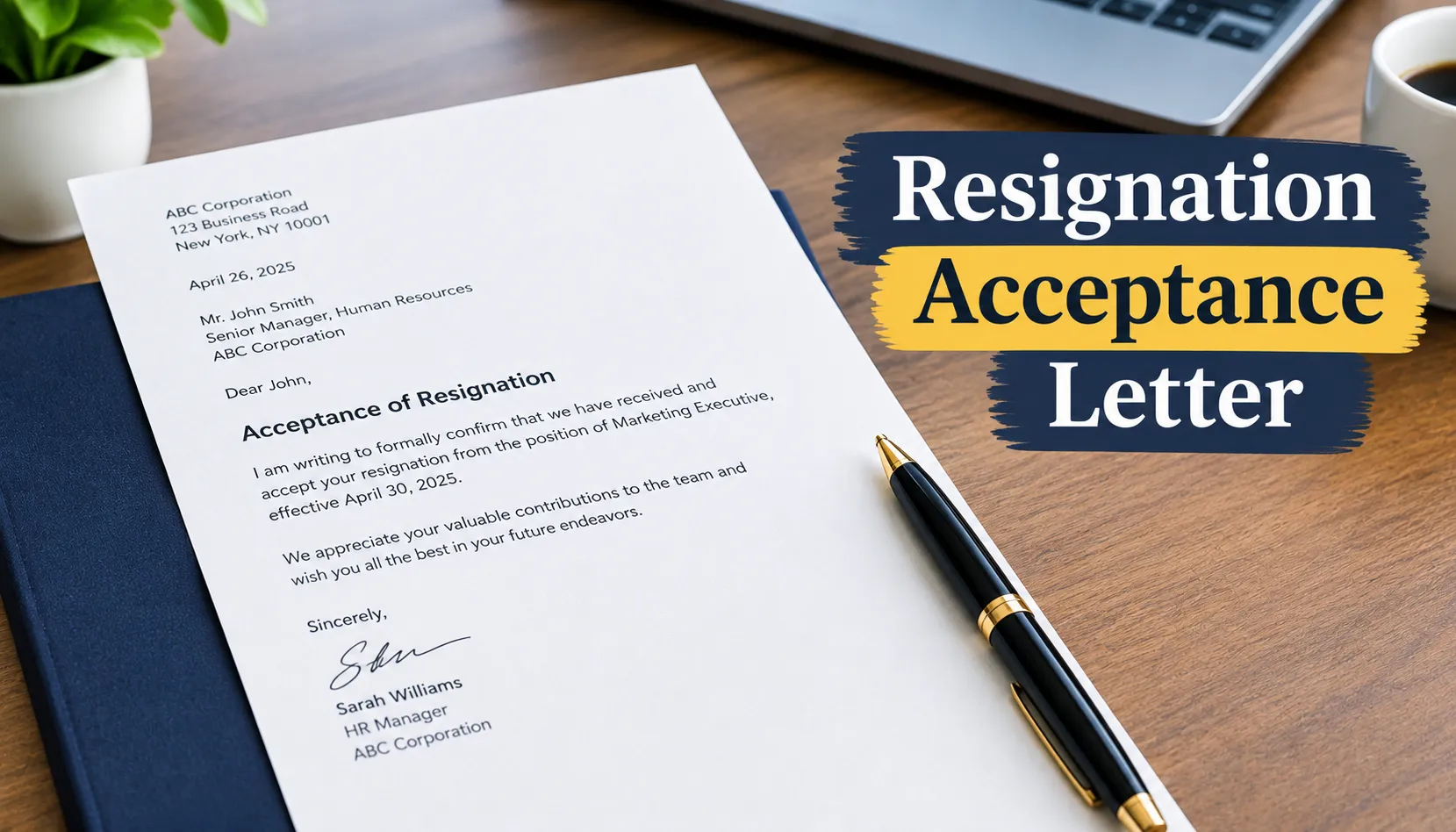
This is to confirm that we have received your resignation letter dated [date] and that your resignation from the position of [Job Title] is accepted. Your last working day will be [date], in line with your notice period.
Please coordinate with [Manager/HR Name] to hand over your current responsibilities before that date. Your final settlement will be processed as per company policy after your exit formalities are complete.
Thank you for your contribution to the team. We wish you the best in whatever comes next.
Sincerely,
[Name]
[Designation], [Company Name]
Sample 2: Short Acceptance Email
Subject: Resignation Accepted
Hi [Employee Name],
Thanks for your letter of [date]. We accept your resignation, and your last working day will be [date]. Please speak with [Name] about handover. We appreciate your work and wish you well.
Regards,
[Name]
Sample 3: Acceptance With Early Release
Dear [Employee Name],
We acknowledge your resignation dated [date] and accept it. After discussion, we are happy to release you on [earlier date], ahead of your standard notice period. Please complete the handover with [Name] by [date].
Thank you for your service, and all the best for your next role.
Sincerely,
[Name], [Designation]
Every one of these assumes the employee’s own letter was clear. If you are also helping an employee draft theirs, the simple resignation letter sample page is a good one to share, and so is the job resignation letter guide for a fuller version.
How to Write Your Own, Step by Step
- Read the resignation first: Note the date submitted, the proposed last day and any requests, such as early release or a leave adjustment.
- Check the notice period: Compare the employee’s proposed date with their contract, which is covered in more detail on the employment resignation letter page.
- Decide on the last day: Accept the date, or confirm a different one if you have agreed on it.
- Write it in plain language: No legal phrasing, no long speeches.
- Send it quickly: Within a day or two is a good habit, so the employee isn’t left guessing.
- File a copy: Keep the acceptance with the original resignation in the employee’s record.
Mistakes to Avoid
- Waiting too long to reply: Silence makes people anxious and can blur the notice period.
- Leaving out the last working day: This is the one detail HR and payroll both need.
- Sounding cold or angry: Even if the resignation hurts, the reply goes in the file, and former employees talk.
- Promising things you can’t deliver: Don’t mention bonuses, dues or references unless they are already confirmed.
- Mixing in a counter-offer: If you want to try to retain the person, do it in a conversation first, and send the acceptance letter only once the decision is final.
- Forgetting to keep a copy: You will want it if there is any dispute later.
Resignation vs Acceptance vs Relieving Letter
These three get mixed up a lot, so here is the difference:
| Document | Written By | Purpose |
| Resignation Letter | Employee | Informs the employer they are leaving |
| Resignation Acceptance Letter | Employer | Confirms receipt and accepts it, with the last working day |
| Relieving Letter | Employer | Issued at the end, confirming the employee is formally released |
If you’re the employee on the other side of this, our resign letter in English page covers the first document in the chain, and the resignation letter format Word page gives you a layout you can paste straight into Word.
Who Uses This Letter?
Mostly managers and HR teams, but also small business owners, school principals and department heads. If you run a school, for example, the resignation letter for teacher page shows what a teacher’s letter usually looks like, which helps you write a fitting reply. For more templates and examples, browse the Resignation Letters, Free Templates and Examples sections, or head back to the Resignation Letter homepage.
Frequently Asked Questions
- Is a resignation acceptance letter mandatory?
No law in most places requires it, but it is standard practice. It gives both sides a written record of the last working day. - Who should sign the letter?
Usually the reporting manager or someone from HR. In small companies, the owner or director often signs it. - Can I send it by email?
Yes. An email is accepted at most companies, especially for remote or hybrid teams. Use a clear subject line and keep a copy in the employee’s file. - How soon should I reply to a resignation?
Within a day or two is a good target. A fast, polite reply keeps the exit smooth. - What if I want to change the last working day?
You can, but agree on it with the employee first. Then state the confirmed date in the acceptance letter so there is no confusion. - Should I mention final settlement and dues?
A brief line is helpful, such as saying dues will be processed per company policy. Avoid giving exact figures or dates unless HR has confirmed them. - Is an acceptance letter the same as a relieving letter?
No. The acceptance letter comes right after the resignation. The relieving letter is issued on or after the last day to confirm the employee has been formally released. - Can an employer refuse to accept a resignation?
In most cases an employee has the right to resign, and what matters is the notice period in the contract. For anything specific to your country or contract, check with HR or a legal professional. If you have questions about the site’s templates, you can contact us.
Conclusion
A good resignation acceptance letter is short, polite and specific. It confirms you received the resignation, says it is accepted, states the last working day, and points to handover and next steps. Send it quickly, keep a copy, and don’t turn it into a speech.
Use the samples above as a starting point, adjust the dates and names, and you can have your reply ready in a few minutes.