
A formal resignation letter is a short, professional document that officially tells your employer you are leaving. It names your job title, states your last working day, and refers to your notice period. Most run 100 to 200 words. You can write one in about ten minutes with the sample below.
If you only need a quick version, jump to the short resignation letter or the simple resignation letter sample. If you are leaving a government post, a large company or a contract role, a formal resignation letter is the safer choice, and this guide covers it from start to finish.
What Is a Formal Resignation Letter?
A formal resignation letter is a written notice that ends your employment in an official, respectful tone. It goes to your manager, HR, or the head of your organisation. It is dated and signed, and it keeps to the facts: who you are, what role you hold, and when you will leave.
HR teams file it as proof of your exit. Many companies will not process your final pay, leave encashment, experience letter or relieving letter until it is on record. That is the main reason to put your resignation in writing even if you have already told your manager in person.
When Should You Use a Formal Resignation Letter?
You don’t need the same level of formality everywhere. Use a formal resignation letter in these cases:
- Government and public sector jobs: Service rules usually require a written, addressed letter.
- Large corporations: HR processes follow a fixed format, and a formal letter fits it.
- Schools and colleges: Teachers usually write to the principal or management. See the resignation letter for teacher and teacher resignation letter to principal guides.
- Contract-heavy roles: If your appointment letter has a notice clause, your letter should refer to it.
- Senior positions: A formal tone protects your reputation and keeps references strong.
For relaxed startups or small teams, a lighter professional version is usually fine.
Formal Resignation Letter Format
A clear format makes it easy for HR to act on your letter. The table below shows what goes where. For a deeper walkthrough, read our full resignation letter format guide.
| Section | What to include | Length |
| Sender details | Your name, address and contact number | 2-3 lines |
| Date | The day you submit the letter | 1 line |
| Recipient details | Manager or authority name, designation, company, address | 3-4 lines |
| Subject line | “Letter of Resignation from the Post of [Job Title]” | 1 line |
| Salutation | “Dear [Name],” or “Respected Sir/Madam,” | 1 line |
| Opening statement | A direct statement that you are resigning | 1-2 sentences |
| Last working day | Exact date, counted from your notice period | 1 sentence |
| Thanks (optional) | A short, honest thank-you | 1-2 sentences |
| Handover offer | Willingness to help with the transition | 1 sentence |
| Closing | “Yours sincerely” or “Yours faithfully,” then your name and signature | 2-3 lines |
Prefer to type it in a document? The resignation letter format Word page has an editable layout.
Formal Resignation Letter Sample
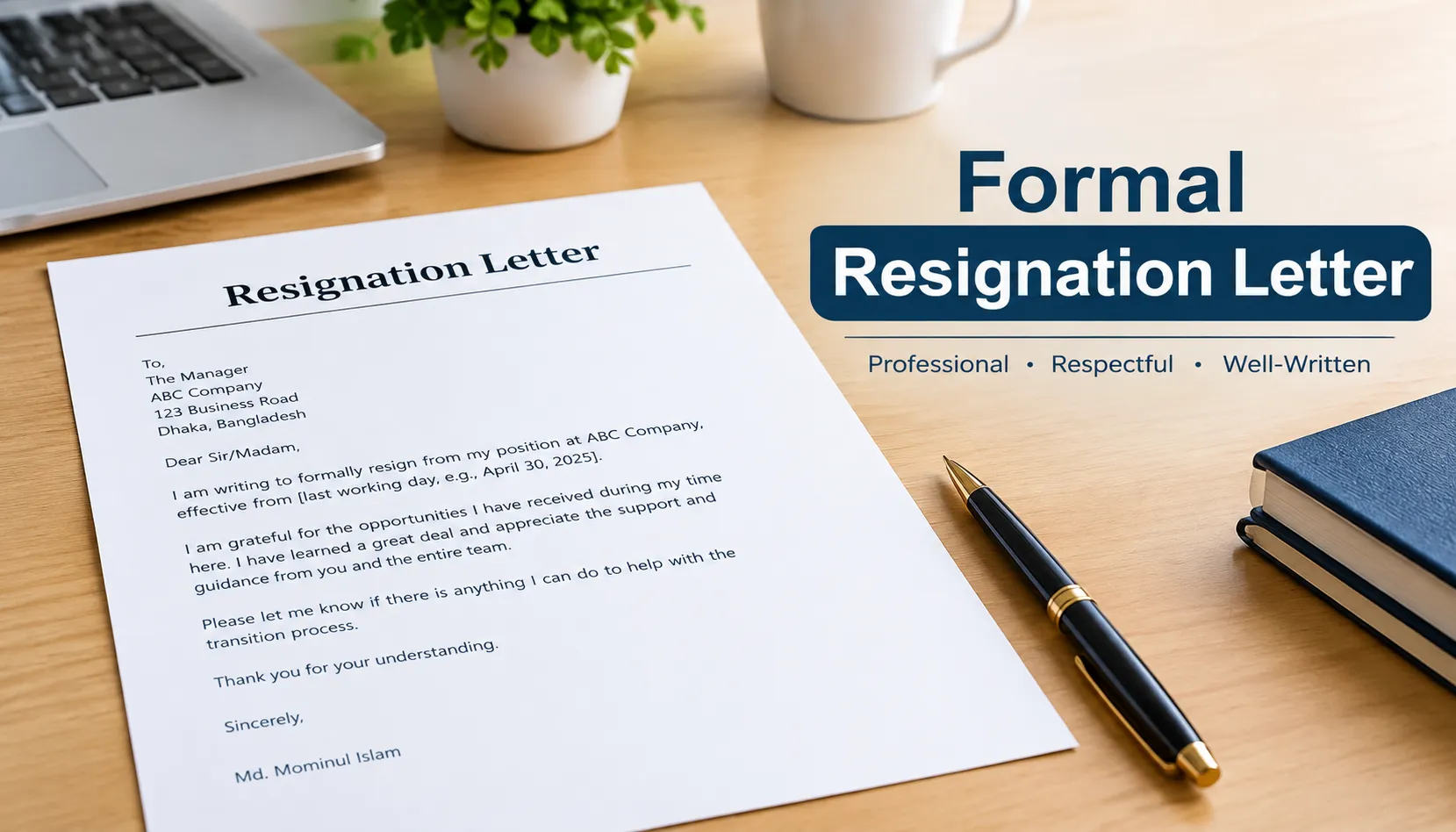
Here is a formal resignation letter you can copy and adapt in a couple of minutes.
[Your Name]
[Your Address]
[Phone Number]
[Date]
To,
[Manager’s Name]
[Designation]
[Company Name]
[Company Address]
Subject: Letter of Resignation from the Post of [Job Title]
Dear [Manager’s Name],
I am writing to formally resign from my position as [Job Title] at [Company Name]. My last working day will be [Date], in line with the [30-day] notice period in my appointment letter.
Thank you for the support and opportunities I have received during my time here. I will complete my pending tasks and help with the handover so the transition is smooth for the team.
Please let me know if you need any documents or further information from me.
Yours sincerely,
[Your Signature]
[Your Full Name]
[Employee ID, if applicable]
Replace the brackets, check the date against your contract, and it is ready. Browse more wording options in the examples category.
Formal Resignation Letter for Government and Public Sector Jobs
Government letters are more traditional. They use “Respected Sir/Madam” and ask the authority to accept the resignation. Here is a version you can use.
To,
The [Designation],
[Department / Organisation Name],
[Address]
Subject: Resignation from the Post of [Job Title]
Respected Sir/Madam,
I hereby tender my resignation from the post of [Job Title], with effect from [Date], as per the notice period in my appointment letter dated [Date].
I request you to kindly accept my resignation and arrange for my relieving and final settlement.
Yours faithfully,
[Your Name]
[Employee ID]
Formal Resignation Email
Most workplaces now accept email, especially for remote and hybrid teams. The content stays the same. The main change is the subject line, which should be clear enough to get opened.
Subject: Resignation: [Your Name], [Job Title]
Dear [Manager’s Name],
Please accept this email as my formal resignation from the position of [Job Title] at [Company Name], effective [Last Working Day].
Thank you for the opportunity. I will make sure my work is handed over properly before I leave.
Regards,
[Your Name]
[Phone Number]
Need subject line ideas? The resignation letter subject guide has more than 30 ready-to-use lines, and the resignation letter email page covers the full email format. Keep a sent copy or a screenshot for your records.
How to Write a Formal Resignation Letter, Step by Step
- Open with the decision. Say you are resigning in the first sentence. Don’t make your manager search for it.
- Name your role and company. This avoids any confusion in large organisations.
- State your last working day. Count it from your notice period and write the exact date.
- Refer to your notice clause. One short phrase such as “as per my appointment letter” is enough.
- Add one line of thanks. Keep it honest and short.
- Offer to help with handover. This is what HR and managers remember.
- Sign off formally. Use “Yours sincerely” if you know the name, “Yours faithfully” if you wrote “Sir/Madam.”
For extra wording choices, read how to write a resignation letter.
You don’t have to explain why you are leaving. “For personal reasons” is enough, and the personal reason resignation letter format shows how to word it.
Formal vs Informal Resignation Letter
| Feature | Formal resignation letter | Informal resignation letter |
| Tone | Official and respectful | Friendly and relaxed |
| Salutation | “Respected Sir/Madam” or “Dear Mr./Ms. [Name]” | “Hi [First Name]” |
| Notice reference | Mentions contract or appointment letter | Often skipped |
| Length | 100-200 words | 40-100 words |
| Best for | Government, corporate, school, senior roles | Startups, small teams, junior roles |
| Delivery | Printed or emailed with a clear subject | Usually email or message |
When you are unsure, go formal. It is easy to sound too polite and very hard to take back a letter that sounded too casual.
How Much Notice Should You Give?
Your contract always wins, but these ranges are typical. Read your offer letter before you fix a last working day.
| Role level | Typical notice period | Notes |
| Entry-level | 15-30 days | Often negotiable |
| Mid-level | 30 days | Common in private companies |
| Senior or managerial | 30-60 days | Longer handover expected |
| Executive | 60-90 days | Clients or board may need time |
| Government or public sector | 30-90 days | Depends on service rules |
| Probation | 1-15 days | Check your offer letter |
| Two weeks’ notice | 14 days | Common in the US |
If you can’t serve the full notice, talk to HR about a buyout or early release before you submit the letter. Don’t try to negotiate inside it. For different situations, see our job resignation letter and employment resignation letter pages. Writing in plain English for an international employer? The resign letter in English page helps.
Common Mistakes to Avoid
- Venting in writing: Save complaints for the exit interview, or skip them. The letter stays in your file for years.
- Leaving out the last working day: It is the most important detail in the letter.
- Guessing the notice period: Check your appointment letter first.
- Over-explaining: One line of reason is plenty, and none is fine.
- Using the wrong closing: “Yours faithfully” goes with “Sir/Madam.” “Yours sincerely” goes with a name.
- Forgetting your own copy: Keep a signed copy or the sent email.
- Typos in names and dates: In a formal letter, these look careless.
Frequently Asked Questions About the Formal Resignation Letter
What is a formal resignation letter?
It is an official written notice that tells your employer you are leaving. It states your job title, your last working day and, usually, a reference to your notice period.
How long should a formal resignation letter be?
Between 100 and 200 words, or about one page. Longer letters tend to include details that don’t belong there.
What should a formal resignation letter include?
Your name, the date, the recipient’s details, a subject line, a clear statement that you are resigning, your last working day, and your signature. A thank-you and a handover offer are optional but recommended.
Do I have to give a reason for resigning?
No. “For personal reasons” or no reason at all is acceptable.
Can I send a formal resignation letter by email?
Yes, in most workplaces. Use a clear subject line, include the same details as a printed letter, and keep a copy of the sent message.
Should I say “Yours sincerely” or “Yours faithfully”?
Use “Yours sincerely” when you address a named person. Use “Yours faithfully” when you begin with “Sir/Madam.”
How much notice should I give?
Follow your contract. Many private employers expect 15 to 30 days, and senior roles often need 60 to 90 days.
What happens after I submit a formal resignation letter?
HR confirms your last working day, plans the handover, and later issues your relieving letter and final settlement. Some employers also hold an exit interview.
Can I withdraw my resignation letter?
Sometimes, but only if your employer agrees. Speak to your manager or HR and ask for the withdrawal in writing.
Conclusion
A good formal resignation letter is short, accurate and polite. It names your role, gives the right last working day, refers to your notice period and leaves a clean record behind you. The structure barely changes whether you are leaving a government post, a school or a large company.
Start with the sample above, check your notice period, and send it. If your situation needs something different, explore our guides on the resignation letter format, how to write a resignation letter and short resignation letter. You can also browse the Resignation Letters category and the free templates category.